Pages

Loading
Showing posts with label James Bond films. Show all posts

Quantum of Solace 2008

A man in a business suit holding a gun with a woman in a black dress walking away from a destroyed facility in the desert. To their left is the title "Quantum Of Solace" in black letters – except the 'O's, which are golden and make a diagonal straight line with a 7 resembling a gun.
Quantum of Solace (2008) is the twenty-second James Bond film produced by Eon Productions, and is the direct sequel to the 2006 film Casino Royale. Directed by Marc Forster, it features Daniel Craig's second performance as James Bond. In the film, Bond seeks revenge for the death of his lover, Vesper Lynd (Eva Green), and is assisted by Camille Montes (Olga Kurylenko), who is plotting revenge for the murder of her family. The trail eventually leads them to wealthy businessman Dominic Greene (Mathieu Amalric), a member of the Quantum organisation, who intends to stage a coup d'état in Bolivia to seize control of that country's water supply.
Producer Michael G. Wilson developed the film's plot while Casino Royale was being shot. Neal Purvis, Robert Wade, Paul Haggis and Joshua Zetumer contributed to the script. Daniel Craig and Marc Forster had to write some sections themselves due to the Writers Strike,[3] though they were not given the screenwriter credit in the final cut. The title was chosen from a 1959 short story in Ian Fleming's For Your Eyes Only, though the film does not contain any elements of the original story. Location filming took place in Mexico, Panama, Chile, Italy, Austria and Wales while interior sets were built and filmed at Pinewood Studios. Forster aimed to make a modern film that also featured classic cinema motifs: a vintage Douglas DC-3 was used for a flight sequence, and Dennis Gassner's set designs are reminiscent of Ken Adam's work on several early Bond films. Taking a course away from the usual Bond villains, Forster rejected any grotesque appearance for the character Dominic Greene to emphasise the hidden and secret nature of the film's contemporary villains.
        James Bond is driving from Lake Garda to Siena, Italy, with the captured Mr. White in the boot of his car. After evading pursuers, Bond and M interrogate White regarding his organisation, Quantum. M's bodyguard, Mitchell, a double agent, attacks M, enabling White to escape. Bond chases Mitchell and kills him. Bond and M return to London and search Mitchell's flat, discovering through tagged banknotes that Mitchell had a contact in Haiti. Bond tracks the contact, Edmund Slate, and learns that Slate is a hitman sent to kill Camille Montes at the behest of her lover, environmentalist Dominic Greene. While observing her subsequent meeting with Greene, Bond learns that Greene is helping an exiled Bolivian General, Medrano—who murdered Camille's family—to overthrow his government in exchange for a seemingly barren piece of desert.
After rescuing Camille from Medrano, Bond follows Greene to a performance of Tosca in Bregenz, Austria. En route, the CIA head of the South American section, Gregg Beam, strikes a non-interference deal with Greene to maintain access to assumed stocks of Bolivian oil. Bond infiltrates Quantum's meeting at the opera, and a gunfight ensues. Greene's men kill a Special Branch bodyguard working for Quantum member Guy Haines, an adviser to the British Prime Minister, after he fights with Bond. M assumes that Bond killed him, and has his passports and credit cards revoked when he refuses to return home and debrief.
Initial release: November 14, 2008 (USA)
Director: Marc Forster
Prequel: Casino Royale
Sequel: Skyfall
Featured song: Another Way to Die

Casino Royale 2006

A man in a business suit with a loose tie holding a gun. Behind him is a silhouette of a woman showing a building with a sign reading "Casino Royale" and a dark grey car below the building. At the bottom left of the image is the title "Casino Royale" – both "O"s stand above each other, and below them is a 7 with a trigger and gun barrel – and the credits.Casino Royale is the twenty-first film in the Eon Productions James Bond film series and the first to star Daniel Craig as fictional MI6 agent James Bond. Directed by Martin Campbell and written by Neal Purvis, Robert Wade and Paul Haggis, the film marks the third screen adaptation of Ian Fleming's 1953 novel of the same name. Casino Royale is set at the beginning of Bond's career as Agent 007, just as he is earning his licence to kill. After preventing a terrorist attack at Miami International Airport, Bond falls for Vesper Lynd, the treasury employee assigned to provide the money he needs to bankrupt terrorist financier Le Chiffre by beating him in a high-stakes poker game. The story arc continues in the following Bond film, Quantum of Solace (2008).
Casino Royale reboots the series, establishing a new timeline and narrative framework not meant to precede or succeed any previous Bond film, which allows the film to show a less experienced and more vulnerable Bond. Additionally, the character Miss Moneypenny is, for the first time in the series, completely absent.Casting the film involved a widespread search for a new actor to portray James Bond, and significant controversy surrounded Craig when he was selected to succeed Pierce Brosnan in October 2005. Location filming took place in the Czech Republic, the Bahamas, Italy and the United Kingdom with interior sets built at Pinewood Studios. Although part of the storyline is set in Montenegro, no filming took place there. Casino Royale was produced by Eon Productions for Metro-Goldwyn-Mayer and Columbia Pictures, making it the first Eon-produced Bond film to be co-produced by the latter studio.
       After killing a traitorous MI6 section chief—who has been selling classified information—and the station chief's contact, James Bond gets his double-0 status with the number 007. He then goes to Madagascar in pursuit of an international bomb-maker named Mollaka. After a parkour chase to an embassy, Bond kills his target and escapes by setting off an explosion. Searching through Mollaka's mobile phone, Bond discovers a text message, which he traces to Alex Dimitrios, an associate of banker and terrorist financier Le Chiffre. Le Chiffre's investments involve short-selling stock in successful companies and then engineering terrorist attacks to sink their share prices.
Bond travels to the Bahamas where Dimitrios has a home and seduces his wife, Solange Dimitrios. After answering a phone call, Solange reveals that her husband is flying to Miami, so Bond leaves to pursue him. In Miami, 007 kills Dimitrios and follows Le Chiffre's henchman, Carlos, to Miami International Airport. There, Bond foils Le Chiffre's plan to destroy the prototype Skyfleet airliner by stopping the fuel truck Carlos was planning to crash into the aeroplane.
Initial release: November 14, 2006 (London)
Director: Martin Campbell
Featured song: You Know My Name
Music composed by: David Arnold
Screenplay: Robert Wade, Neal Purvis, Paul Haggis

Die Another Day 2002

Die another Day - UK cinema poster.jpgDie Another Day (2002) is the twentieth spy film in the James Bond series, and the fourth and last film to star Pierce Brosnan as the fictional MI6 agent James Bond. The film follows Bond as he leads a mission to North Korea, during which he is betrayed and, after seemingly killing a rogue North Korean colonel, is captured and imprisoned. More than a year later Bond is released as part of a prisoner exchange. Surmising that someone within the British government betrayed him, he attempts to earn redemption by tracking down his betrayer and killing a North Korean agent he believes was involved in his torture.
Die Another Day, produced by Michael G. Wilson and Barbara Broccoli, and directed by Lee Tamahori, marks the James Bond franchise's 40th anniversary. The series began in 1962 with Sean Connery starring as Bond in Dr. No. Die Another Day includes references to each of the preceding films.
      James Bond infiltrates a North Korean military base, where Colonel Tan-Sun Moon is illegally trading African conflict diamonds for weaponry. After Moon's assistant Zao discovers that Bond is a British agent, the colonel attempts to kill Bond and a hovercraft chase ensues, which ends with Moon's apparent death. Bond survives, but is captured by North Korean soldiers and imprisoned by the Colonel's father, General Moon.
After 14 months of captivity and torture, Bond is traded for Zao in a prisoner exchange. He is sedated and taken to meet M, who informs him that his status as a 00 Agent is suspended due to her belief that he may have leaked information under duress. Bond is convinced that he has been set up by a double agent in the British government and decides to avenge his betrayal. After escaping from the custody of MI6, he travels to Hong Kong, where he learns from a Chinese agent that Zao is in Cuba.
Initial release: November 22, 2002 (USA)
Director: Lee Tamahori
Featured song: Die Another Day
Screenplay: Robert Wade, Ian Fleming, Neal Purvis
Awards: Razzie Award for Worst Supporting Actress, NAACP Image Award for Outstanding Supporting Actress in a Motion Picture

The World Is Not Enough 1999

Poster shows a circle with Bond flanked by two women at the centre. Globs of fire and action shots from the film are below. The film's name is at the bottom.The World Is Not Enough (1999) is the nineteenth spy film in the James Bond series, and the third to star Pierce Brosnan as the fictional MI6 agent James Bond. The film was directed by Michael Apted, with the original story and screenplay written by Neal Purvis, Robert Wade and Bruce Feirstein. It was produced by Michael G. Wilson and Barbara Broccoli. The title is taken from a line in the 1963 novel On Her Majesty's Secret Service.The film's plot revolves around the assassination of billionaire Sir Robert King by the terrorist Renard, and Bond's subsequent assignment to protect King's daughter Elektra, who had previously been held for ransom by Renard. During his assignment, Bond unravels a scheme to increase petroleum prices by triggering a nuclear meltdown in the waters of Istanbul.
      MI6 agent James Bond meets a Swiss banker to retrieve money for Sir Robert King, a British oil tycoon and friend of M. Bond tells the banker that King was buying a report stolen from an MI6 agent who was killed for it, and wants to know who killed him. The banker threatens Bond, but Bond overpowers him. The banker is killed by his assistant before he can reveal the assassin's name. Bond escapes with the money.
Back in London, Sir Robert is killed by the booby-trapped money inside MI6. Bond gives chase to the assassin – the assistant again – on a boat on the Thames to the Millennium Dome, where the assassin attempts to escape via hot air balloon. Bond offers her protection, but she refuses. She detonates the balloon, killing herself.
Initial release: November 19, 1999 (USA)
Director: Michael Apted
Featured song: The World is Not Enough
Music composed by: David Arnold
Screenplay: Robert Wade, Bruce Feirstein, Neal Purvis

Tomorrow Never Dies 1997

A man wearing evening dress holds a gun. On his sides are a white woman in a white dress and an Asian woman in a red, sparkling dress holding a gun. On the background are monitors with scenes of the film, with two at the top showing a man wearing glasses holding a baton. On the bottom of the screen are two images of the 007 logo under the title "Tomorrow Never Dies" and the film credits.Tomorrow Never Dies (1997) is the eighteenth spy film in the James Bond series, and the second to star Pierce Brosnan as the fictional MI6 agent James Bond. Directed by Roger Spottiswoode, with the screenplay written by Bruce Feirstein, the film follows Bond as he attempts to stop a power-mad media mogul from engineering world events to initiate World War III.The film was produced by Michael G. Wilson and Barbara Broccoli, and was the first James Bond film made after the death of producer Albert R. Broccoli, to whom the movie pays tribute in the end credits. Filming locations included France, Thailand, Germany, Mexico and the United Kingdom. Tomorrow Never Dies performed well at the box office and earned a Golden Globe nomination despite mixed reviews. While its performance at the domestic box office surpassed that of its predecessor, GoldenEye, it was the only Pierce Brosnan Bond film not to open at number one at the box office as it opened the same day as Titanic.
      MI6 sends James Bond, agent 007, into the field to spy on a terrorist arms bazaar on the Russian border. Via television, MI6 and the Royal Navy identify several wanted men, including American "techno-terrorist" Henry Gupta, who is buying a GPS encoder made by the U.S. military. Despite M's insistence to let 007 finish his reconnaissance, British Admiral Roebuck launches a missile attack on the arms bazaar. Bond then discovers two Soviet nuclear torpedoes mounted on an L-39 Albatros, and as the missile is too far along to be aborted, 007 hijacks the L-39 and flies away seconds before the bazaar is struck. Amidst the confusion, Gupta escapes with the encoder.
Media baron Elliot Carver, head of the Carver Media Group Network (CMGN), begins his plans to use the encoder to provoke war between China and the United Kingdom, which would replace the current Chinese government with one more supportive to Carver's plans of exclusive broadcast rights. Meaconing the GPS signal using the encoder, Gupta sends the British frigate HMS Devonshire off-course into Chinese-held waters in the South China Sea, where Carver's stealth ship, commanded by Mr. Stamper, sinks the frigate with a sea drill and steals one of its missiles. Afterwards, Stamper's men shoot down a Chinese J-7 fighter jet sent to investigate the British presence, and kill the Devonshire's survivors with Chinese weaponry. After reading a CMGN report of the incident as a Chinese attack, Roebuck deploys the British Fleet to recover the frigate, and possibly retaliate, leaving M only forty-eight hours to investigate its sinking.
Initial release: December 12, 1997 (Iceland, Republic of Ireland, United Kingdom)
Director: Roger Spottiswoode
Featured song: Tomorrow Never Dies
Screenplay: Bruce Feirstein
Initial DVD release: May 6, 1998

GoldenEye 1995

GoldenEye - UK cinema poster.jpgGoldenEye (1995) is the seventeenth spy film in the James Bond series, and the first to star Pierce Brosnan as the fictional MI6 officer James Bond. The film was directed by Martin Campbell and is the first film in the series not to take story elements from the works of novelist Ian Fleming. The story was conceived and written by Michael France, with later collaboration by other writers. In the film, Bond fights to prevent an arms syndicate from using the GoldenEye satellite weapon against London in order to cause a global financial meltdown.GoldenEye was released in 1995 after a six-year hiatus in the series caused by legal disputes, during which Timothy Dalton resigned from the role of James Bond and was replaced by Pierce Brosnan. M was also recast, with actress Judi Dench becoming the first woman to portray the character, replacing Robert Brown. GoldenEye was the first Bond film made after the dissolution of the Soviet Union and the end of the Cold War, which provided a background for the plot.
       In 1986 MI6 officers James Bond—agent 007—and Alec Trevelyan—agent 006—infiltrate an illicit Soviet chemical weapons facility at Arkhangelsk and plant explosive charges. Trevelyan is shot by Colonel Arkady Ourumov, but Bond steals an aeroplane and flees from the facility as it explodes.
Nine years later, Bond arrives in Monte Carlo to follow Xenia Onatopp, a suspected member of the Janus crime syndicate, who has formed a suspicious relationship with a Royal Canadian Navy admiral. She murders the admiral to allow Ourumov (now a General) to steal his identity. The next day they steal a prototype Eurocopter Tiger helicopter that can withstand an electromagnetic pulse. They fly it to a bunker in Severnaya, where they massacre the staff and steal the control disk for the dual GoldenEye satellite weapons. They program one of the GoldenEye satellites to destroy the complex with an electromagnetic pulse, and escape with programmer Boris Grishenko. Natalya Simonova, the lone survivor, contacts Boris and arranges to meet him in St. Petersburg, where he betrays her to Janus.
Initial release: November 17, 1995 (USA)
Director: Martin Campbell
Featured song: GoldenEye
Screenplay: Bruce Feirstein, Jeffrey Caine
Story by: Michael France, Ian Fleming

Licence to Kill 1989

In the left of the picture stands a man dressed in black pointing a pistol towards the viewer. An inset picture shows two women looking out of the poster above another man and a few images depicting vehicles and explosions. The name '007' appears in the top right whilst in the centre at the bottom are the words "LICENCE TO KILL"Licence to Kill, released in 1989, is the sixteenth entry in the James Bond film series by Eon Productions, and the first one not to use the title of an Ian Fleming story. It is the fifth in a row and last to be directed by John Glen. It also marks Timothy Dalton's second and final performance in the role of James Bond. The story has elements of two Ian Fleming short stories and a novel, interwoven with aspects from Japanese Rōnin tales. The film sees Bond being suspended from MI6 as he pursues drugs lord Franz Sanchez, who has attacked his CIA friend Felix Leiter and murdered Felix's wife during their honeymoon. Originally titled Licence Revoked in line with the plot, the name was changed during post-production.
Budgetary reasons made Licence to Kill the first Bond not to be shot in the United Kingdom, with locations in both Florida and Mexico. The film earned over $156 million worldwide, and enjoyed a generally positive critical reception, with ample praise for the stunts, but some criticism on Dalton's interpretation of Bond and the fact that the film was significantly darker and more violent than its predecessors.
       DEA agents collect James Bond—MI6 agent 007—and his friend, now DEA agent Felix Leiter, on their way to Leiter's wedding in Key West, to have them assist in capturing drugs lord Franz Sanchez. Bond and Leiter capture Sanchez by attaching a hook and cord to Sanchez's plane in flight near The Bahamas and pulling it out of the air with a Coast Guard helicopter. Afterwards, Bond and Leiter parachute down to the church in time for the ceremony.
Sanchez bribes DEA agent Ed Killifer and escapes. Meanwhile, Sanchez's henchman Dario and his crew ambush Leiter and his wife Della. Leiter is maimed by a great white shark and Della is raped and killed. When Bond learns Sanchez has escaped, he returns to Leiter's house to find Della dead and Felix alive, but seriously wounded; Bond swears to take his revenge on Sanchez. As the DEA refuse to help because Sanchez is out of their jurisdiction, Bond, with Felix's friend Sharkey, start their own investigation into what happened to Felix. The pair discover a marine research centre run by Milton Krest, one of Sanchez's henchmen.
Initial release: July 14, 1989 (USA)
Director: John Glen
Featured song: Licence to Kill
Prequel: The Living Daylights
Sequel: GoldenEye

The Living Daylights 1987

The Living Daylights - UK cinema poster.jpgThe Living Daylights (1987) is the fifteenth entry in the James Bond film series and the first to star Timothy Dalton as the fictional MI6 agent James Bond. The film's title is taken from Ian Fleming's short story, "The Living Daylights". It was the last film to use the title of an Ian Fleming story until the 2006 instalment Casino Royale.The beginning of the film resembles the short story, in which Bond acts as a counter-sniper to protect a Soviet defector, Georgi Koskov. He tells Bond that General Pushkin, head of the KGB, is systematically killing British and American agents. When Koskov is seemingly snatched back, Bond follows him across Europe, Morocco and Afghanistan.
        James Bond—Agent 007—is assigned to aid the defection of a KGB officer, General Georgi Koskov, covering his escape from a concert hall in Bratislava, Czechoslovakia during the orchestra's intermission. During the mission, Bond notices that the KGB sniper assigned to prevent Koskov's escape is a female cellist from the orchestra. Disobeying his orders to kill the sniper, he instead shoots the rifle from her hands, then uses the Trans-Siberian Pipeline to smuggle Koskov across the border into Austria and then on to Britain.
In his post-defection debriefing, Koskov informs MI6 that the KGB's old policy of Smiert Spionam, meaning Death to Spies, has been revived by General Leonid Pushkin, the new head of the KGB. Koskov is later abducted from the safe-house and assumed to have been taken back to Moscow. Bond is directed to track down Pushkin in Tangier and kill him in order to forestall further killings of agents and escalation of tensions between the Soviet Union and the West. Although Bond's prior knowledge of Pushkin initially leads him to doubt Koskov's claims, he agrees to carry out the mission when he learns that the assassin who killed 004 (as depicted in the pre-title sequence) left a note bearing the same message, "Smiert Spionam.".
Initial release: 1987
Director: John Glen
Featured song: The Living Daylights
Initial DVD release: October 17, 2000
Prequel: A View to a Kill

A View to a Kill 1985

A View to a Kill - UK cinema poster.jpgA View to a Kill (1985) is the fourteenth spy film of the James Bond series, and the seventh and last to star Roger Moore as the fictional MI6 agent James Bond. Although the title is adapted from Ian Fleming's short story "From a View to a Kill", the film is the fourth Bond film after The Spy Who Loved Me, Moonraker and Octopussy to have an entirely original screenplay. In A View to a Kill, Bond is pitted against Max Zorin, who plans to destroy California's Silicon Valley.
The film was produced by Albert R. Broccoli and Michael G. Wilson, who also wrote the screenplay with Richard Maibaum. It was the third James Bond film to be directed by John Glen, and the last to feature Lois Maxwell as Miss Moneypenny.
      James Bond is sent to Siberia to locate the body of 003 and recover a microchip originating from the Soviet Union. Upon his return Q analyses the microchip, establishing it to be a copy of one designed to withstand an electromagnetic pulse and made by government contractor Zorin Industries.
Bond visits Ascot Racecourse to observe the company's owner, Max Zorin. Zorin's horse wins a race but proves hard to control. Sir Godfrey Tibbett, a racehorse trainer and MI6 agent, believes Zorin's horse was drugged, although tests proved negative. Through Tibbett, Bond meets French private detective Achille Aubergine who informs Bond that Zorin is holding a horse sale later in the month. During their dinner at the Eiffel Tower, Aubergine is assassinated by Zorin's bodyguard May Day, who subsequently escapes, despite being chased by Bond.
Initial release: May 22, 1985 (San Francisco)
Director: John Glen
Featured song: A View to a Kill
Story by: Ian Fleming
Screenplay: Richard Maibaum, Michael G. Wilson

Octopussy 1983

Octopussy - UK cinema poster.jpgOctopussy (1983) is the thirteenth entry in the James Bond film series, and the sixth to star Roger Moore as the fictional MI6 agent James Bond.The film's title is taken from a short story in Ian Fleming's 1966 short story collection Octopussy and The Living Daylights, although the film's plot is original. It does, however, include a portion inspired by the Fleming short story "The Property of a Lady" (included in 1967 and later editions of Octopussy and The Living Daylights), while the events of the short story "Octopussy" form a part of the title character's background and are recounted by her.Produced by Albert R. Broccoli and Michael G. Wilson, Octopussy was released in the same year as the non-Eon Bond film Never Say Never Again. Written by George MacDonald Fraser, Richard Maibaum, and Michael G. Wilson, the film was directed by John Glen.
          British agent 009 is found dead at the British embassy in East Berlin, dressed as a circus clown and carrying a fake Fabergé egg. MI6 immediately suspects Soviet involvement and sends James Bond—agent 007—to investigate, after seeing the real egg appear at an auction in London, ordering the agent to find out who the seller is. At the auction, Bond is able to swap the real egg with the fake, and engages in a bidding war with exiled Afghan prince Kamal Khan, forcing Khan to pay £500,000 for the fake egg. Bond follows Khan back to his palace in Rajasthan, India, where Bond defeats Khan in a game of backgammon. Bond escapes with his Indian colleague Vijay, evading Khan's bodyguard Gobinda's attempts to kill them both. Bond is seduced by one of Khan's associates, Magda, and notices that she has a blue-ringed octopus tattoo. Magda steals the real Fabergé egg fitted with a listening device by Q, while Gobinda captures Bond and takes him to Khan's palace. After Bond escapes from his cell he listens in on the bug in the Fabergé egg and discovers that Khan is working with Orlov, a Soviet general, who is seeking to expand Soviet borders into Europe.
After escaping the palace, Bond infiltrates a floating palace in Udaipur, India, and there finds its owner, Octopussy, a wealthy woman who leads the Octopus cult, of which Magda is a part. In Octopussy's palace, Bond finds out that Orlov has been supplying Khan with priceless Soviet treasures, replacing them with replicas, while Khan has been smuggling the real versions into the West, via Octopussy's circus troupe. Orlov is planning to meet Khan at Karl-Marx-Stadt (Chemnitz) in East Germany, where the circus is scheduled to perform. After evading Khan's assassins, who kill Vijay, Bond goes to East Germany.
Initial release: June 6, 1983
Director: John Glen
Featured song: All Time High
Screenplay: Richard Maibaum, Michael G. Wilson, George MacDonald Fraser
Story by: Richard Maibaum, Ian Fleming, Michael G. Wilson, George MacDonald Fraser

For Your Eyes Only 1981

A graphic, taking up three quarters of the image, on black background with the bottom quarter in red. Above the picture are the words "No one comes close to JAMES BOND 007". The graphic contains a stylised pair of women's legs and buttocks in the foreground: a pair of bikini bottoms cover some of the bottom. The woman wears high heels and is carrying a crossbow in her right hand. In the distance, viewed between her legs, a man in a dinner suit is seen side on, carrying a pistol. In the red, below the graphic, are the words: "Roger Moore as Ian Fleming's James Bond 007 in FOR YOUR EYES ONLY".For Your Eyes Only (1981) is the twelfth spy film in the James Bond series, and the fifth to star Roger Moore as the fictional MI6 agent James Bond. It marked the directorial debut of John Glen, who had worked as editor and second unit director in three other Bond films.
The screenplay by Richard Maibaum and Michael G. Wilson takes its characters and combines the plots from two short stories from Ian Fleming's For Your Eyes Only collection: the title story and "Risico". In the plot, Bond attempts to locate a missile command system while becoming tangled in a web of deception spun by rival Greek businessmen along with Melina Havelock, a woman seeking to avenge the murder of her parents. Some writing elements were inspired by the novels Live and Let Die, Goldfinger and On Her Majesty's Secret Service.
        The British spy boat St Georges, which holds the Automatic Targeting Attack Communicator (ATAC), the system used by the Ministry of Defence to communicate with and co-ordinate the Royal Navy's fleet of Polaris submarines, is sunk by a naval mine in the Ionian Sea. MI6 agent James Bond, code name "007", is ordered by the Minister of Defence, Sir Fredrick Gray and MI6 Chief of Staff, Bill Tanner, to retrieve the ATAC before the Soviets, as the transmitter could order attacks by the submarines' Polaris ballistic missiles.
The head of the KGB, General Gogol has also learnt of the fate of the St Georges and already notified his contact in Greece. A marine archaeologist, Sir Timothy Havelock, who had been asked by the British to secretly locate the St Georges, is murdered with his wife by a Cuban hitman, Hector Gonzales. Bond goes to Spain to find out who hired Gonzales.
Initial release: June 24, 1981
Director: John Glen
Featured song: For Your Eyes Only
Initial DVD release: October 19, 1999
Prequel: Moonraker

Moonraker 1979

Moonraker (UK cinema poster).jpgMoonraker (1979) is the eleventh spy film in the James Bond series, and the fourth to star Roger Moore as the fictional MI6 agent James Bond. The third and final film in the series to be directed by Lewis Gilbert, it co-stars Lois Chiles, Michael Lonsdale, Corinne Cléry, and Richard Kiel. Bond investigates the theft of a space shuttle, leading him to Hugo Drax, the owner of the shuttle's manufacturing firm. Along with space scientist Dr. Holly Goodhead, Bond follows the trail from California to Venice, Rio de Janeiro, and the Amazon rainforest, and finally into outer space to prevent a plot to wipe out the world population and to re-create humanity with a master race.Moonraker was intended by its creator Ian Fleming to become a film even before he completed the novel in 1954, since he based it on a screenplay manuscript he had written even earlier. The film's producers had originally intended to film For Your Eyes Only, but instead chose this title due to the rise of the science fiction genre in the wake of the Star Wars phenomenon. Budgetary issues caused the film to be primarily shot in France, with locations also in Italy, Brazil, Guatemala and the United States. The soundstages of Pinewood Studios in England, traditionally used for the series, were only used by the special effects team.
          A Drax Industries Moonraker space shuttle on loan to the United Kingdom is hijacked in mid-air and MI6 operative, James Bond, agent 007, is assigned to investigate. En route to England in a small charter plane, Bond is attacked by the pilot and crew and pushed out of the plane by the mercenary assassin Jaws. Bond survives by stealing a parachute from the pilot, whilst Jaws lands on a circus tent.
Bond proceeds to the Drax Industries shuttle-manufacturing complex where he meets the owner of the company, Hugo Drax, and henchman Chang. Bond also meets an astronaut, Dr. Holly Goodhead and survives an assassination attempt via a centrifuge chamber. Bond is later aided by Drax's personal pilot, Corinne Dufour, as he finds blueprints for a glass vial made in Venice. Bond then foils another attempt on his life, using a hunting shotgun to shoot a sniper. Upon discovering that Dufour assisted Bond's investigations, Drax has her killed.
Bond again encounters Goodhead in Venice where he is chased through the canals by Drax's henchmen. He discovers a secret biological laboratory, and by accidentally poisoning the scientists there, he learns that the glass vials are to hold a nerve gas deadly to humans, but harmless to animals. Chang attacks Bond and is killed, but during the fight, Bond finds evidence that Drax is moving his operation to Rio de Janeiro. Rejoining Goodhead, he deduces that she is a CIA agent spying on Drax. They promise to work together, but quickly dispense with the truce. Bond has saved one of the vials he found earlier, as the only evidence of the now-empty laboratory, giving it to M for analysis, who permits him to go to Rio de Janeiro under the pretence of being on leave.
Initial release: June 29, 1979 (USA)
Director: Lewis Gilbert
Featured song: Moonraker
Budget: 34 million USD
Initial DVD release: May 16, 2000

The Spy Who Loved Me 1977

The Spy Who Loved Me (UK cinema poster).jpgThe Spy Who Loved Me (1977) is the tenth spy film in the James Bond series, and the third to star Roger Moore as the fictional secret agent James Bond. It was directed by Lewis Gilbert and the screenplay was written by Christopher Wood and Richard Maibaum.The film takes its title from Ian Fleming's novel The Spy Who Loved Me, the tenth book in the James Bond series, though it does not contain any elements of the novel's plot. The storyline involves a reclusive megalomaniac named Karl Stromberg, who plans to destroy the world and create a new civilisation under the sea. Bond teams up with a Russian agent Anya Amasova to stop Stromberg. Curd Jürgens and Barbara Bach co-star.
British and Soviet ballistic-missile submarines mysteriously disappear. James Bond—MI6 agent 007—is summoned to investigate. On the way, he escapes an ambush by Soviet agents in Austria, killing one during a downhill ski chase, and escaping via a Union Flag parachute. Bond learns that the plans for a highly advanced submarine tracking system are on the market in Egypt. There, he encounters Major Anya Amasova—KGB agent Triple X—his rival for the plans. They travel across Egypt together, tracking the microfilm plans, meeting Jaws—an unnaturally tall assassin with steel teeth—along the way. Bond and Amasova later team up, due to a truce supported by their respective superiors, and identify the person responsible for the thefts as shipping tycoon, scientist, and anarchist Karl Stromberg.While travelling by train to Stromberg's base in Sardinia, Bond saves Amasova from being killed by Jaws, and their rivalry changes into affection. Posing as a marine biologist and his wife, they visit Stromberg's base and discover that he has a mysterious new supertanker, the Liparus. After they leave the base, Jaws and other armed men, including a helicopter pilot named Naomi, chase them, but all attempts fail due to Bond's driving skills and fact that his car – a Lotus Esprit from Q Branch – can convert into a submarine. Jaws retreats once again while Naomi and her other allies are killed. Bond later finds out that the Liparus has never visited any known port or harbour, and Amasova learns that Bond killed her lover in Austria; she promises Bond that she will kill him when their mission ends.
Initial release: July 13, 1977 (USA)
Director: Lewis Gilbert
Featured song: Nobody Does It Better
Screenplay: Richard Maibaum, Christopher Wood
Story by: Ian Fleming, Christopher Wood

The Man with the Golden Gun 1974

A man in a dinner jacket holding a pistol is in the centre of the picture. Various scenes and images surround him, including two women in bikinis, a midget with a pistol, a car stunt and explosions. At the bottom right, oversized and pointing towards the man in the dinner jacket, is a golden gun, with a hand holding a bullet, about to load the gun. The top of the picture has the words "ROGER MOORE as JAMES BOND 007". At the bottom are the words "THE MAN WITH THE GOLDEN GUN".The Man with the Golden Gun (1974) is the ninth spy film in the James Bond series and the second to star Roger Moore as the fictional MI6 agent James Bond. A loose adaptation of Ian Fleming's novel of same name, the film has Bond sent after the Solex Agitator, a device that can harness the power of the sun, while facing the assassin Francisco Scaramanga, the "Man with the Golden Gun". The action culminates in a duel between them that settles the fate of the Solex.The Man with the Golden Gun was the fourth and final film in the series directed by Guy Hamilton. The script was written by Richard Maibaum and Tom Mankiewicz. The film was set in the face of the 1973 energy crisis, a dominant theme in the script—Britain had still not yet fully overcome the crisis when the film was released in December 1974. The film also reflects the then-popular martial arts film craze, with several kung-fu scenes and a predominantly Asian location, being shot in Thailand, Hong Kong, and Macau.
In London, a golden bullet with James Bond's code "007" etched into its surface is received by MI6. It is believed that it was sent by famed assassin Francisco Scaramanga, who uses a golden gun, to intimidate the agent. Because of the perceived threat to the agent's life, M relieves Bond of a mission revolving around the work of a scientist named Gibson, thought to be in possession of information crucial to solving the energy crisis with solar power. Bond sets out unofficially to find Scaramanga.After retrieving a spent golden bullet from a belly dancer in Beirut and tracking its manufacturer to Macau, Bond sees Andrea Anders, Scaramanga's mistress, collecting golden bullets at a casino. Bond follows her to Hong Kong and in her Peninsula Hotel room pressures her to tell him about Scaramanga, his appearance and his plans; she directs him to the Bottoms Up Club. The club proves to be the location of Scaramanga's next 'hit', Gibson, from which Scaramanga's dwarf henchman Nick Nack steals the "Solex agitator", a key component of a solar power station. Before Bond can assert his innocence, however, Lieutenant Hip escorts him away from the scene, taking him to meet M and Q in a hidden headquarters in the wreck of the RMS Queen Elizabeth in the harbour. M assigns 007 to retrieve the Solex agitator and assassinate Scaramanga.
Initial release: December 20, 1974 (USA)
Director: Guy Hamilton
Featured song: The Man with the Golden Gun
Story by: Ian Fleming
Screenplay: Tom Mankiewicz, Richard Maibaum

Diamonds Are Forever 1971

Diamonds Are Forever - UK cinema poster.jpgDiamonds Are Forever (1971) is the seventh spy film in the James Bond series by Eon Productions, and the sixth and final Eon film to star Sean Connery as the fictional MI6 agent James Bond.The film is based on Ian Fleming's 1956 novel of the same name, and is the second of four James Bond films directed by Guy Hamilton. The story has Bond impersonating a diamond smuggler to infiltrate a smuggling ring, and soon uncovering a plot by his old nemesis Ernst Stavro Blofeld to use the diamonds to build a giant laser. Bond has to battle his nemesis for one last time, in order to stop the smuggling and stall Blofeld's plan of destroying Washington DC, and extorting the world with nuclear supremacy.
    James Bond—agent 007—pursues Ernst Stavro Blofeld and eventually finds him at a facility where Blofeld look-alikes are being created through surgery. Bond kills a test subject, and later the "real" Blofeld, by drowning him in a pool of superheated mud.While assassins Mr. Wint and Mr. Kidd systematically kill several diamond smugglers, M suspects that South African diamonds are being stockpiled to depress prices by dumping, and orders Bond to uncover the smuggling ring. Disguised as professional smuggler and assassin Peter Franks, Bond travels to Amsterdam to meet contact Tiffany Case. The real Franks shows up on the way, but Bond intercepts and kills him, then switches IDs to make it seem like Franks is Bond. Case and Bond then go to Los Angeles, smuggling the diamonds inside Franks' corpse.
Initial release: December 14, 1971
Director: Guy Hamilton
Featured song: Diamonds Are Forever
Story by: Ian Fleming
Screenplay: Tom Mankiewicz, Richard Maibaum

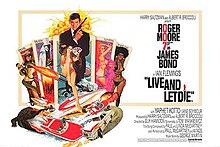
Live and Let Die 1973

Live and Let Die- UK cinema poster.jpgLive and Let Die (1973) is the eighth spy film in the James Bond series to be produced by Eon Productions, and the first to star Roger Moore as the fictional MI6 agent James Bond. Produced by Albert R. Broccoli and Harry Saltzman, it was the third of four Bond films to be directed by Guy Hamilton. Although the producers had wanted Sean Connery to return after his role in the previous Bond film Diamonds Are Forever, he declined, sparking a search for a new actor to play James Bond. Moore was signed for the lead role.The film is adapted from the novel of the same name by Ian Fleming. In the film, a Harlem drugs lord known as Mr. Big plans to distribute two tons of heroin free to put rival drugs barons out of business. Mr. Big is revealed to be the disguised alter ego of Dr. Kananga, a corrupt Caribbean dictator, who rules San Monique, the fictional island where the heroin poppies are secretly farmed. Bond is investigating the death of three British agents, leading him to Kananga, and is soon trapped in a world of gangsters and voodoo as he fights to put a stop to the drugs baron's scheme.
       Three MI6 agents, including one "on loan" to the American government, are killed within 24 hours, under mysterious circumstances, while monitoring the operations of Dr. Kananga, the dictator of a small Caribbean island, San Monique. James Bond, agent 007, is sent to New York to investigate the first murder. Kananga is also in New York, visiting the United Nations. Just after Bond arrives, his driver is shot dead by a passing motorist, while taking Bond to meet Felix Leiter of the CIA. Bond is nearly killed in the ensuing car crash.
Glastron speedboats in the Louisiana boat chase. The boat chase scene was filmed in the Bayou Des Allemands.A trace on the killer's licence plate eventually leads Bond to Mr. Big, a ruthless gangster who runs a chain of Fillet of Soul restaurants throughout the United States. It is here that Bond first meets Solitaire, a beautiful virgin tarot expert who has the ability to see both the future and remote events in the present. Mr. Big, who is actually Kananga in disguise, demands that his henchmen kill Bond, but Bond overpowers them and escapes unscathed. Bond flies to San Monique, where he meets Rosie Carver, a CIA double agent. They meet up with a friend of Bond's, Quarrel Jr., who takes them by boat to Solitaire's home. Bond suspects Rosie of working for Kananga. She is shot dead, remotely, by Kananga, to stop her confessing the truth to Bond. Inside Solitaire's house, Bond uses a stacked tarot deck of cards, that show only "The Lovers", to trick her into thinking that seduction is in her future, and then seduces her. Solitaire loses her ability to foretell the future when she loses her virginity to Bond, and is forced into cooperating with Bond to bring down Kananga.
Initial release: June 27, 1973 (USA)
Director: Guy Hamilton
Featured song: Live and Let Die (main title)
Screenplay: Tom Mankiewicz
Story by: Ian Fleming

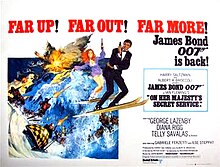
On Her Majesty's Secret Service 1969

A man in a dinner jacket on skis, holding a gun. Next to him is a red-headed woman, also on skis and with a gun. They are being pursued by men on skis and a bobsleigh, all with guns. In the top left of the picture are the words FAR UP! FAR OUT! FAR MORE! James Bond 007 is back!On Her Majesty's Secret Service (1969) is the sixth spy film in the James Bond series, based on the 1963 novel of the same name by Ian Fleming. Following the decision of Sean Connery to retire from the role after You Only Live Twice, Eon Productions selected an unknown actor and model, George Lazenby, to play the part of James Bond. During the making of the film, Lazenby decided that he would play the role of Bond only once.In the film, Bond faces Blofeld (Telly Savalas), who is planning to sterilise the world's food supply through a group of brainwashed "angels of death" (which included early appearances by Joanna Lumley and Catherina von Schell) unless his demands are met for an international amnesty, for recognition of his title as the Count De Bleuchamp (the French form of Blofeld) and to be allowed to retire into private life. Along the way, Bond meets, falls in love with, and eventually marries Contessa Teresa di Vicenzo (Diana Rigg).
        In Portugal, James Bond – agent 007, sometimes referred to simply as '007' – saves a woman on the beach from committing suicide by drowning, and later meets her again in a casino. The woman, Contessa Teresa "Tracy" di Vicenzo, invites Bond to her hotel room to thank him. The next morning, Bond is kidnapped by several men while leaving the hotel, who take him to meet Marc-Ange Draco, the head of the European crime syndicate Unione Corse. Draco reveals that Tracy is his only daughter and tells Bond of her troubled past, offering Bond a personal dowry of one million pounds if he will marry her. Bond refuses, but agrees to continue romancing Tracy under the agreement that Draco reveals the whereabouts of Ernst Stavro Blofeld, the head of SPECTRE.
Initial release: December 13, 1969 (Japan)
Director: Peter R. Hunt
Prequel: You Only Live Twice
Sequel: Diamonds Are Forever
Featured song: We Have All the Time in the World

You Only Live Twice 1967

Poster showing small, open-cockpit helicopters flying in the skyYou Only Live Twice (1967) is the fifth spy film in the James Bond series, and the fifth to star Sean Connery as the fictional MI6 agent James Bond. The film's screenplay was written by Roald Dahl, and loosely based on Ian Fleming's 1964 novel of the same name. It is the first James Bond film to discard most of Fleming's plot, using only a few characters and locations from the book as the background for an entirely new story.In the film, Bond is dispatched to Japan after American and Soviet manned spacecraft disappear mysteriously in orbit. With each nation blaming the other amidst the Cold War, Bond travels secretly to a remote Japanese island in order to find the perpetrators and comes face to face with Ernst Stavro Blofeld, the head of SPECTRE. The film reveals the appearance of Blofeld who was previously a partially unseen character. SPECTRE is extorting the government of an unnamed Asian power, implied to be the People's Republic of China, in order to provoke war between the superpowers.
        An American spacecraft is hijacked from orbit by another, unidentified spacecraft. The U.S. suspect it to be the Soviets, but the British suspect Japanese involvement since the spacecraft landed in the Sea of Japan. To investigate, MI6 operative James Bond—agent 007—is sent to Tokyo after faking his own death and being buried at sea off HMS Tenby (F65).Upon his arrival, Bond is contacted by Aki, assistant to the Japanese secret service leader Tiger Tanaka. Aki introduces Bond to local MI6 operative Dikko Henderson. Henderson claims to have critical evidence about the rogue craft but is killed before he can elaborate. Bond chases and kills the assailant, disguises himself and escapes in the getaway car, which takes him to Osato Chemicals. Once there, Bond subdues the driver and breaks into the office safe of president Mr. Osato. After stealing documents, Bond is chased out by armed security, eventually being picked up by Aki, who flees to a secluded subway station. Bond chases her, but falls down a trap door leading to Tanaka's office. The stolen documents are examined and found to include a photograph of the cargo ship Ning-Po with a microdot message saying the tourist who took the photo was killed as a security precaution.
Initial release: June 12, 1967
Director: Lewis Gilbert
Featured song: You Only Live Twice
Screenplay: Roald Dahl
Story by: Ian Fleming

Thunderball 1965

Thunderball - UK cinema poster.jpgThunderball (1965) is the fourth spy film in the James Bond series starring Sean Connery as the fictional MI6 agent James Bond. It is an adaptation of the novel of the same name by Ian Fleming, which in turn was based on an original screenplay by Jack Whittingham. It was directed by Terence Young with screenplay by Richard Maibaum and John Hopkins.
        James BondMI6 agent 007 and sometimes simply "007"—attends the funeral of Colonel Jacques Bouvar, a SPECTRE operative (Number 6). Bouvar is alive and disguised as his own widow, but Bond identifies him. Following him to a château, Bond fights and kills him, escaping using a jetpack and his Aston Martin DB5.Bond is sent by M to a clinic to improve his health. While massaged by physiotherapist Patricia Fearing, he notices Count Lippe, a suspicious man with a criminal tattoo (from a Tong). He searches Lippe's room, but is seen leaving by Lippe's clinic neighbour who is bandaged after plastic surgery. Lippe tries to murder Bond with a spinal traction machine, but is foiled by Fearing, whom Bond then seduces. Bond finds a dead bandaged man, François Derval. Derval was a French NATO pilot deployed to fly aboard an Avro Vulcan loaded with two atomic bombs for a training mission. He had been murdered by Angelo, a SPECTRE henchman surgically altered to match his appearance.
Initial release: December 20, 1965 (USA)
Director: Terence Young
Featured song: Thunderball
Awards: Academy Award for Best Visual Effects
Screenplay: Richard Maibaum, Jack Whittingham, John Hopkins

Goldfinger 1964

On a black background, a woman in underwear painted gold stands on the left. An image of Bond and a woman is projected on the right side of the woman's body. On the left is a phrase of the tagline: "James Bond Back in Action". Below is the title and credits.Goldfinger (1964) is the third film in the James Bond series and the third to star Sean Connery as the fictional MI6 agent James Bond. It is based on the novel of the same name by Ian Fleming. The film also stars Honor Blackman as Bond girl Pussy Galore and Gert Fröbe as the title character Auric Goldfinger, along with Shirley Eaton as famous Bond girl Jill Masterson. Goldfinger was produced by Albert R. Broccoli and Harry Saltzman and was the first of four Bond films directed by Guy Hamilton.
        After destroying a drug laboratory in Latin America, James Bondagent 007—goes to Miami Beach. There he receives instructions from his superior, M, via CIA agent Felix Leiter to observe bullion dealer Auric Goldfinger, who is staying at the same hotel as Bond. The agent sees Goldfinger cheating at gin rummy and stops him by distracting his employee, Jill Masterson, and blackmailing Goldfinger into losing. Bond and Jill consummate their new relationship; however, Bond is subsequently knocked out by Goldfinger's Korean manservant Oddjob. When Bond regains consciousness, he finds Jill dead, covered in gold paint, having died from "epidermal suffocation".In London, Bond learns that his objective is determining how Goldfinger smuggles gold internationally. Bond arranges to meet Goldfinger socially and wins a high-stakes golf game against him with a recovered Nazi gold bar at stake. Bond follows him to Switzerland, where Tilly, Jill Masterson's sister, makes an unsuccessful attempt at revenge by firing a sniper rifle at Goldfinger.Bond sneaks into Goldfinger's plant and discovers that he smuggles the gold by melting it down and incorporating it into the bodywork of his car, which he takes with him whenever he travels. Bond also overhears him talking to a Red Chinese agent named Mr. Ling about "Operation Grand Slam". Leaving, Bond encounters Tilly as she tries to kill Goldfinger again, but trips an alarm in the process; Oddjob kills Tilly with his hat. Bond is captured and Goldfinger ties Bond to a cutting table underneath an industrial laser, which begins to slice a sheet of gold in half, with Bond lying over it. Bond lies to Goldfinger that MI6 knows about Grand Slam, causing Goldfinger to spare Bond's life to mislead MI6 into believing that Bond has things in hand.
Initial release: September 17, 1964 (United Kingdom, USA)
Director: Guy Hamilton
Featured song: Goldfinger
Awards: Academy Award for Best Sound Editing, Golden Laurel, BAFTA Award for Best British Art Direction (Colour)
Screenplay: Richard Maibaum, Paul Dehn
Loading

Labels

1931's Movies 1936's Movies 1940's Movies 1962's Movies 1963's Movies 1964's Movies 1965's Movies 1967's Movies 1969's Movies 1971's Movies 1973's Movies 1974's Movies 1977's Movies 1979's Movies 1981's Movies 1983's Movies 1985's Movies 1986's Movies 1987's Movies 1988's Movies 1989's Movies 1990's Movies 1991's Movies 1992's Movies 1993's Movies 1994's Movies 1995's Movies 1996's Movies 1997'Movies 1998'Movies 1999's Movies 2000's Movies 2001's Movies 2002's Movies 2003's Movies 2004's Movies 2005's Movies 2006's Movies 2007's Movies 2008's Movies 2009's Movies 2010's Movies 2011's Movies 2012's Movies 2013's Movies 2014's Films 2014's Movies 9121's Movies Absurdism Action Action Comedy Action Film Action Thriller Action/Adventure Adventure Comedy Adventure Film Alien Film Animation Anti-war film Auto racing B movie Biographical film Biography Black comedy Black-and-white Blaxploitation film Buddy cop film Buddy film Caper story Chase Movie Classic Movies Comedy Comedy Thriller Comedy-drama Coming of age Computer Animation Concert film Costume Adventure Costume drama Crime Crime Drama Crime Fiction Crime Thriller Cult film Danish Disaster Film Documentary Doomsday film Drama Dubbed In Hindi Dystopia ensemble Ensemble Film Epic film Erotic thriller Existentialism Family Family Drama Fantasy farce Fiction Film adaptation Film noir Film Review Full Movies Future noir Gangster Film Glamorized Spy Film HD Historical drama Historical fiction Horror Horror comedy Indie film James Bond films Kaiju Legal drama Leonardo DiCaprio LGBT Mark Wahlberg Melodrama Monster movie Music Musical Musical comedy Musical Drama Mystery Natural horror film Neo-noir New film Parody Part-talkie Period piece Plot Political cinema Political drama Political thriller Psychological thriller Reboot Release date remake Revenge Revenge Drama Road movie Romance Film Romantic comedy Satire Sci-Fi Adventure Sci-Fi Horror Science Fiction Screwball comedy Sex comedy Short Film Silent film Slapstick Slasher Spaghetti Western Sports Spy fiction Spy film Stop motion Superhero movie Suspense Swashbuckler film Teaser Teen Film Thriller Time travel Tom Cruise Trailer Trial drama War film Western Workplace Comedy World cinema Zombie Film