Pages

Loading
Showing posts with label Leonardo DiCaprio. Show all posts

Django Unchained 2012

Django Unchained Poster.jpgDjango Unchained (/ˈdʒæŋɡoʊ/) is a 2012 American western film written and directed by Quentin Tarantino, who made the film as a very stylized variation of the spaghetti Western, which takes place in the Old West, but primarily taking place in America's pre-Civil War South. The film stars Jamie Foxx, Christoph Waltz, Leonardo DiCaprio, Kerry Washington, and Samuel L. Jackson, and was released December 25, 2012 (Christmas Day), in North America.[5][6]
The story is set in early winter and then spring, during the antebellum era of the Deep South with preliminary scenes taking place in Old West Texas. The film follows an African-American slave (Foxx), and an English-speaking, German bounty hunter posing as a traveling dentist (Waltz), named Dr. Schultz. In exchange for helping Schultz collect a large bounty on three outlaws (hiding-in-plain-sight in the south, working in the slave trade) that he has never seen – but Django has, while being trafficked – Schultz buys and then promises to free Django after they catch the outlaws the following spring. Schultz also promises to teach Django bounty hunting, and split the bounties with him, if Django assists him in hunting down other outlaws throughout the winter. Django agrees – on the condition that they also locate and free his long-lost wife (Washington) from her cruel plantation owner (DiCaprio).
     Somewhere in Texas in the year 1858, several male African slaves are being 'driven' by the Speck Brothers, Ace and Dicky. Among the shackled slaves is Django, sold off and separated from his wife, Broomhilda. The Speck Brothers are stopped by Dr. King Schultz, a German dentist and bounty hunter from Düsseldorf. Schultz asks to buy one of the slaves, but while questioning Django about his knowledge of the Brittle Brothers, for whom Schultz is carrying a warrant, he irritates Ace who aims his shotgun at Schultz. Schultz quickly kills Ace and leaves Dicky at the mercy of the other newly freed slaves, who blow his head off. Since Django can identify the Brittle Brothers, Schultz offers Django his freedom in exchange for his help in tracking them down. After executing the Brittles, Django partners with Schultz through the winter and becomes his apprentice. Schultz explains that, being the first person he has ever given freedom to, he feels responsible for Django and is driven to help him in his quest to rescue Broomhilda.
Django, now fully trained, collects his first bounty, keeping the handbill as a good luck charm. In Mississippi, Schultz uncovers the identity of Broomhilda's owner: Calvin Candie, the charming but brutal owner of the Candyland plantation, where slaves are forced to fight to the death in wrestling matches called "Mandingo fights." Schultz, expecting Candie will demand an extortionate amount if they are forthright, devises a ruse to purchase one of Candie's prized fighters, purchase Broomhilda on the side for a reasonable sum, then disappear before the deal is finalized. Schultz and Django meet Candie at a club in Greenville and submit their offer. His greed tickled, Candie invites them to Candyland. After he secretly debriefs Broomhilda on the plan, Schultz moves to the next step, claiming to be charmed by the German-speaking Broomhilda.
Release date: December 25, 2012 (USA)
Director: Quentin Tarantino
Running time: 180 minutes
Featured songs: Freedom, I Got a Name, Django (Main Theme), Ancora Qui, Who Did That To You?, 100 Black Coffins
Awards: Academy Award for Best Actor in a Supporting Role, Academy Award for Best Original Screenplay, Golden Globe Award for Best Screenplay - Motion Picture, Golden Globe Award for Best Supporting Actor – Motion Picture, MTV Movie Award for Best WTF Moment, BAFTA Award for Best Original Screenplay, BET Award for Best Actress, BAFTA Award for Best Actor in a Supporting Role, National Board of Review Award for Best Supporting Actor, Broadcast Film Critics Association Award for Best Screenplay, NAACP Image Award for Outstanding Supporting Actor in a Motion Picture, BET Award for Best Actor, NAACP Image Award for Outstanding Supporting Actress in a Motion Picture, AACTA International Award for Best Screenplay, David di Donatello for Best Foreign Film

Inception 2010

A man in a suit with a gun in his right hand is flanked by five other individuals in the middle of a street which, behind them, is folded upwards. Leonardo DiCaprio's name and those of other cast members are shown above the words "Your Mind Is the Scene of the Crime". The title of the film "INCEPTION", film credits, and theatrical and IMAX release dates are shown at the bottom.Inception is a 2010 British-American science fiction heist thriller film written, co-produced, and directed by Christopher Nolan. The film stars a large ensemble cast that includes Leonardo DiCaprio, Ellen Page, Joseph Gordon-Levitt, Marion Cotillard, Ken Watanabe, Tom Hardy, Dileep Rao, Cillian Murphy, Tom Berenger, and Michael Caine. DiCaprio plays Dom Cobb, a professional thief who commits corporate espionage by infiltrating the subconscious of his targets. He is offered a chance of redemption as payment for a task considered to be impossible: "inception", the implantation of another person's idea into a target's subconscious.Shortly after finishing Insomnia (2002), Nolan wrote an 80-page treatment about "dream stealers" envisioning a horror film inspired by lucid dreaming and presented the idea to Warner Bros.Feeling he needed to have more experience with large-scale film production, Nolan retired the project and instead worked on Batman Begins (2005), The Prestige (2006), and The Dark Knight (2008). He spent six months revising the script before Warner Bros. purchased it in February 2009.Inception was filmed in six countries and four continents, beginning in Tokyo on June 19, 2009, and finishing in Canada on November 22, 2009. Its official budget was US$160 million; a cost which was split between Warner Bros and Legendary Pictures. Nolan's reputation and success with The Dark Knight helped secure the film's $100 million in advertising expenditure, with most of the publicity involving viral marketing.
       Dominick "Dom" Cobb (Leonardo DiCaprio) and business partner Arthur (Joseph Gordon-Levitt) are "extractors", people who perform corporate espionage using an experimental military technology to infiltrate the subconscious of their targets and extract information while experiencing shared dreaming. Their latest target is Japanese businessman Saito (Ken Watanabe). The extraction from Saito fails when sabotaged by a memory of Cobb's deceased wife Mal (Marion Cotillard). After Cobb's and Arthur's associate sells them out, Saito reveals that he was actually auditioning the team to perform the difficult act of "inception": planting an idea in a person's subconscious.
In order to break up the energy conglomerate of ailing competitor Maurice Fischer (Pete Postlethwaite), Saito wants Cobb to plant the idea of dissolving the company into the mind of Fischer's heir, son Robert Fischer (Cillian Murphy). Should Cobb succeed, Saito tells Cobb he will use his influence to clear Cobb of a murder charge, which will allow Cobb to return home and to his children. Cobb accepts Saito's offer. Cobb sets about assembling his team: Eames (Tom Hardy), a conman and identity forger; Yusuf (Dileep Rao), a chemist who concocts the powerful sedative for a stable "dream within a dream" strategy; Ariadne (Ellen Page), an architecture student tasked with designing the labyrinth of the dream landscapes; and Arthur. Saito insists on accompanying the team to verify the team's success.
Initial release: July 8, 2010 (United Kingdom)
Director: Christopher Nolan
Running time: 148 minutes
Screenplay: Christopher Nolan
Awards: Academy Award for Best Cinematography, Academy Award for Best Visual Effects, Critics Choice Award for Best Action Film, Academy Award for Best Sound Mixing, Academy Award for Best Sound Editing, Saturn Award for Best Music, American Society of Cinematographers Award for Outstanding Achievement in Cinematography in Theatrical Releases, MTV Movie Award for Best Scared-As-S**t Performance, BAFTA Award for Best Sound, Hugo Award for Best Dramatic Presentation, Long Form, Writers Guild of America Award for Best Original Screenplay, BAFTA Award for Best Special Visual Effects, Screen Actors Guild Award for Outstanding Performance by a Stunt Ensemble in a Motion Picture, Saturn Award for Best Director, Satellite Award for Best Art Direction and Production Design, BFCA Critics' Choice Award for Best Art Direction, BFCA Critics' Choice Award for Best Editing, BFCA Critics' Choice Award for Best Visual Effects, Satellite Award for Best Original Score, Satellite Award for Best Cinematography, Broadcast Film Critics Association Award for Best Cinematography, Florida Film Critics Circle Award for Best Cinematography, Chicago Film Critics Association Award for Best Cinematography, BFCA Critics' Choice Award for Best Sound, San Diego Film Critics Society Award for Best Cinematography, ADG Excellence in Production Design Awards - Fantasy Film, National Society of Film Critics Award for Best Production Design, NME Awards for Best Film, Washington DC Area Film Critics Association Award for Best Cinematography, BAFTA Award for Best Production Design, Las Vegas Film Critics Society Award for Best Cinematography

Shutter Island 2010

Shutterislandposter.jpgShutter Island is a 2010 American psychological thriller film directed by Martin Scorsese. The film is based on Dennis Lehane's 2003 novel of the same name. Production started in March 2008. Leonardo DiCaprio stars as U.S. Marshal Edward "Teddy" Daniels, who is investigating a psychiatric facility on the titular island. Positively cited by movie reviewers, the film grossed over $128 million in its initial domestic theater release, as well as an additional $166 million internationally.Shutter Island was originally slated to be released on October 2, 2009, but Paramount Pictures pushed the release date to February 19, 2010.
        In 1954, two U.S. Marshals, Edward "Teddy" Daniels and his new partner, Chuck Aule, travel to the Ashecliffe Hospital for the criminally insane on Shutter Island located in Boston Harbor, as part of an investigation into the disappearance of patient Rachel Solando, incarcerated for drowning her three children. The sole clue is a note left by Solando, which reads: "The law of 4; who is 67?" Shortly after arrival, a storm prevents their return to the mainland for several days. Daniels finds the staff confrontational: the lead psychiatrist, Dr. John Cawley, refuses to hand over records of the hospital staff; Solando's doctor, Dr. Sheehan, had left on vacation after her disappearance, and they are barred from searching Ward C and told that the lighthouse on the island has already been searched, so there is no need to search it.
The unpleasant air and commodity of the Ashecliffe Hospital causes Daniels to start having migraine headaches, waking visions of his involvement in the Dachau liberation reprisals, and disturbing dreams of his wife, Dolores Chanal, who was killed in a fire set by a local arsonist named Andrew Laeddis. In one dream, Chanal tells Daniels that Solando is still on the island, as well as Laeddis, who also went missing months ago. Daniels later explains to Aule that locating Laeddis was an ulterior motive for taking the case.
Initial release: February 13, 2010 (Berlin)
Director: Martin Scorsese
Running time: 138 minutes
Screenplay: Laeta Kalogridis
Awards: Teen Choice Award for Choice Movie Actor: Horror/Thriller

Revolutionary Road 2008

Revolutionary road.jpgRevolutionary Road is a 2008 American drama film, based on the 1961 novel of the same name by Richard Yates, directed by Sam Mendes. This is the second collaboration between Leonardo DiCaprio and Kate Winslet, who previously co-starred in Titanic. Winslet's performance earned her a Golden Globe Award for Best Actress, and the film was nominated for a further three Golden Globes, four BAFTAs and three Oscars.The film premiered in Los Angeles on 15 December 2008, followed by a limited U.S. release on 26 December 2008 and a wide U.S. release on 23 January 2009. In most other countries it was released between 15 and 30 January 2009.
      In the late 1940s, Frank Wheeler (Leonardo DiCaprio) meets April (Kate Winslet) at a party. He is a longshoreman, hoping to be a cashier; she wants to be an actress. Frank later secures a sales position with Knox Machines, for which his father worked for twenty years, and he and April marry. The Wheelers move to 115 Revolutionary Road in suburban Connecticut when April becomes pregnant. Frank and April settle into the normality of suburban life while bringing up their children, Michael and Jennifer.
The couple becomes close friends with their realtor Helen Givings (Kathy Bates) and her husband Howard Givings (Richard Easton), and neighbor Milly Campbell (Kathryn Hahn) and her husband Shep (David Harbour). To their friends, the Wheelers are the perfect couple, but their relationship is troubled. April fails to make a career out of acting, while Frank hates the tedium of his work. April wants new scenery and a chance to support the family so that Frank can find his passion.
Initial release: December 15, 2008 (USA)
Director: Sam Mendes
Screenplay: Justin Haythe
Story by: Richard Yates
Awards: Golden Globe Award for Best Actress – Motion Picture – Drama, Satellite Award for Best Supporting Actor – Motion Picture, London Film Critics Circle Award for Actress of the Year

Body of Lies 2008

Body of lies poster.jpgBody of Lies is a 2008 American action-spy film directed by Ridley Scott. Set in the Middle East, it follows the attempts of the CIA and Jordanian Intelligence to catch "al-Saleem", a fictional jihadist terrorist. Frustrated by their target's elusiveness, differences in their approaches strain relations between a CIA operative, his superior, and the head of Jordanian Intelligence.William Monahan's screenplay, based on the novel of the same name by David Ignatius, examines contemporary tension between Western and Arab societies and the comparative effectiveness of technological and human counter-intelligence methods. The film was shot largely on location in the United States and Morocco, after authorities in Dubai refused permission to film there because of the script's political themes. The film's photography sought to emphasize the contrast between the gold and dust of the desert and Arab cities, and the blue and gray of bureaucracy and Washington. Accordingly, they used natural light wherever possible. Marc Streitenfeld arranged the musical score.
       Roger Ferris (Leonardo DiCaprio) is a CIA case officer in Iraq, tracking a terrorist called Al-Saleem (Alon Abutbul). He meets Nizar, a member of the terrorist organization who is prepared to offer information in return for asylum in America. Despite his boss Ed Hoffman (Russell Crowe)'s objections, Ferris agrees to shelter Nizar. Nizar is used as a pawn to draw out the rest of his cell, when he is captured Ferris is forced to shoot him to prevent him from exposing Ferris' identity. Furious at Hoffman's refusal to act on the information Nizar provided, Ferris and his associate Bassam (Oscar Isaac) go to search a safehouse in Balad, Iraq, which Nizar had told them of. There, Ferris observes men burning records and attempts to bluff his way in, but is exposed. In the ensuing shootout and chase, Ferris and Bassam's vehicle is hit by an RPG. Ferris and some salvaged discs are rescued by helicopter but Bassam is killed in the explosion.
Meanwhile, unknown terrorists plan to follow up off-screen bus bombings in Sheffield with more attacks in Manchester but blow themselves up when the police arrive at their house. Recovered from his injuries, Ferris is assigned to Jordan to continue searching for Al-Saleem, where he meets with Hani Salaam (Mark Strong), head of the Jordanian General Intelligence Directorate.
Hoffman finds an Al-Saleem safe house in Jordan and orders Ferris to surveil it. Simultaneously, Hoffman organizes another 'side operation' via a local agency operative named Skip (Vince Colosimo) and that he is to conduct an operation without Ferris' knowledge. Skip employs the use of an agency asset, Ziyad Abishi who blows cover to a terrorist from the safe house, as he flees to inform his colleagues of their exposure, Ferris makes chase and kills him in such a place and manner that one might believe the death to be random. Salaam (via 'back channels') corroborates the acceptance of killing by those whom remain at the safe house; and Ferris accuses Hoffman of running "side operations" which interfere and (at least) undermine operational integrity of primary operation and tells Hoffman to stop. While going to the hospital to receive rabies shots for bites suffered during the pursuit and elimination of the terrorist, Ferris meets a nurse named Aisha (Golshifteh Farahani), and he begins developing romantic feelings for her. The bombers strike again in an Amsterdam flower market, and kill at least 75 people.
Initial release: October 10, 2008 (USA)
Director: Ridley Scott
Running time: 128 minutes
Featured song: If the World
Screenplay: William Monahan

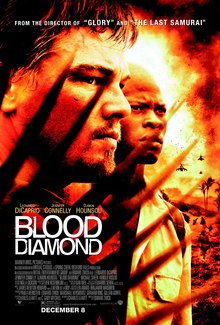
Blood Diamond 2006

Blooddiamondposter.jpgBlood Diamond is a 2006 American-German political war thriller film co-produced and directed by Edward Zwick, starring Leonardo DiCaprio, Jennifer Connelly and Djimon Hounsou. The title refers to blood diamonds, which are diamonds mined in African war zones and sold to finance conflicts, and thereby profit warlords and diamond companies across the world.Set during the Sierra Leone Civil War in 1996–2001, the film depicts a country torn apart by the struggle between government loyalists and insurgent forces. It also portrays many of the atrocities of that war, including the rebels' amputation of people's hands to discourage them from voting in upcoming elections.
         It is 1999 and the troubled West African nation of Sierra Leone is ravaged by major political unrest. Rebel factions such as the Revolutionary United Front frequently terrorize the open countryside, intimidating Mende locals and enslaving many to harvest diamonds, which fund their increasingly successful war effort. One such unfortunate is fisherman Solomon Vandy (Djimon Hounsou), from Shenge, who has been assigned to a workforce overseen by a ruthless warlord, Captain Poison (David Harewood).On a particularly tense morning, Vandy discovers an enormous pink diamond in the riverbank and buries it in the soft earth. Captain Poison learns of the stone, but before he can act on this knowledge the area is raided by government security forces. Both men are subsequently incarcerated in Freetown along with Danny Archer (Leonardo DiCaprio), a white Rhodesian gunrunner jailed while attempting to smuggle diamonds into Liberia for corrupt South African mining executive Rudolph van de Kaap (Marius Weyers).
Initial release: December 8, 2006 (USA)
Director: Edward Zwick
Music composed by: James Newton Howard
Awards: NAACP Image Award for Outstanding Supporting Actor in a Motion Picture
Screenplay: Marshall Herskovitz, Edward Zwick

The Aviator 2004

The Aviator Poster.jpgThe Aviator is a 2004 American biographical drama film directed by Martin Scorsese, written by John Logan, produced by Michael Mann, Sandy Climan, Graham King, and Charles Evans, Jr., and starring Leonardo DiCaprio as Howard Hughes, Cate Blanchett as Katharine Hepburn and Kate Beckinsale as Ava Gardner. The supporting cast features Ian Holm, John C. Reilly, Alec Baldwin, Jude Law as Errol Flynn, Gwen Stefani as Jean Harlow, Willem Dafoe, Alan Alda, and Edward Herrmann. The film depicts the true story of aviation pioneer Howard Hughes, who later became the world's wealthiest man, drawing upon numerous sources including a biography by Charles Higham. The picture centers on Hughes' life from the late 1920s to 1947, during which time he became a successful film producer and an aviation magnate while simultaneously growing more unstable due to severe obsessive-compulsive disorder exacerbated by airplane crashes.The Aviator was nominated for 11 Academy Awards, including Best Picture, Best Director for Scorsese, Best Original Screenplay, Best Actor in a Leading Role for DiCaprio,Best Actor in a Supporting Role for Alan Alda and Best Sound Mixing, and winning five for Best Cinematography, Best Film Editing, Best Costume Design, Best Art Direction and Best Actress in a Supporting Role for Cate Blanchett. This feat would later be duplicated by Scorsese's film Hugo seven years later.
            In 1914, nine-year-old Howard Hughes is being bathed by his mother. She warns him of disease, afraid that he will succumb to a flu outbreak: "You are not safe." By 1927, Hughes (Leonardo DiCaprio) has inherited his family's fortune and is living in California. He hires Noah Dietrich (John C. Reilly) to run the Hughes Tool Company.
Following an interest in film and aviation, at the age of 22, Hughes begins directing the silent film, Hell's Angels. He becomes obsessed with shooting the film realistically and when the The Jazz Singer, the first partially talking film, premieres, he converts Hell's Angels to a sound film. As a result, it takes several years and an enormous amount of money to finish. Finally, despite press skepticism, Hell's Angels is a hit. However, Hughes is unsatisfied with the end result and orders the film re-cut after its Hollywood premiere. He later produces Scarface (1932) and The Outlaw (1943).
Initial release: December 25, 2004 (USA)
Director: Martin Scorsese
Running time: 170 minutes
Screenplay: John Logan
Awards: Academy Award for Best Actress in a Supporting Role, Golden Globe Award for Best Actor – Motion Picture – Drama, BAFTA Award for Best Film, Golden Globe Award for Best Motion Picture – Drama, Academy Award for Best Cinematography, Academy Award for Best Costume Design, Academy Award for Best Film Editing, Academy Award for Best Production Design, Golden Globe Award for Best Original Score, BFCA Critics' Choice Award for Best Composer, BAFTA Award for Best Makeup & Hair, BAFTA Award for Best Actress in a Supporting Role, Screen Actors Guild Award for Outstanding Performance by a Female Actor in a Supporting Role, London Film Critics Circle Award for Director of the Year, MTV Movie Award for Best Male Performance, Broadcast Film Critics Association Award for Best Director, Satellite Award for Best Visual Effects, Las Vegas Film Critics Society Award for Best Costume Design, Los Angeles Film Critics Association Award for Best Production Design, PGA Producer of the Year Award for Motion Picture Producer of the Year, Las Vegas Film Critics Society Award for Best Art Direction, Special Silver Ribbon, San Diego Film Critics Society Award for Best Production Design, BAFTA Award for Best Production Design

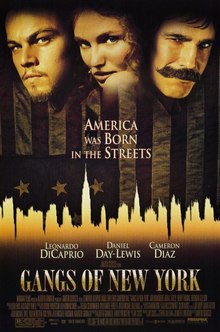
Gangs of New York 2002

Gangs of New York Poster.jpgGangs of New York is a 2002 American historical drama film set in the mid-19th century in the Five Points district of Lower Manhattan. The film was directed by Martin Scorsese and written by Jay Cocks, Steven Zaillian, and Kenneth Lonergan, inspired by Herbert Asbury's 1928 non-fiction book, The Gangs of New York. It was made in Cinecittà, Rome, distributed by Miramax Films and nominated for numerous awards, including the Academy Award for Best Picture.The film begins in 1846 but quickly jumps to 1862. The two principal issues of the era in New York were Irish immigration to the city and the Federal government's execution of the ongoing Civil War. The story follows Bill "the Butcher" Cutting (Daniel Day-Lewis) in his roles as crime boss and political kingmaker under the helm of "Boss" Tweed (Jim Broadbent). The film culminates in a violent confrontation between Cutting and his mob with protagonist Amsterdam Vallon (Leonardo DiCaprio) and his allies, which coincides with the New York Draft Riots of 1863.
        On February 6, 1846, at Paradise Square in Lower Manhattan's Five Points, a territorial battle of hand-to-hand combat between Bill "the Butcher" Cutting's U.S.-born nativist gang, the Natives, and "Priest" Vallon's Irish Catholic immigrant gang, the Dead Rabbits, concludes when Cutting kills Vallon, witnessed by Vallon's young son, Amsterdam. Cutting declares the Dead Rabbits outlawed but orders that Vallon's body be buried with honor. Amsterdam seizes the knife used to kill his father, races off, and buries it along with a medal his father gave him. He is later raised at Hellgate orphanage.
In late 1862, an adult Amsterdam Vallon returns to Five Points and reunites with an old friend, Johnny Sirocco, who reintroduces Amsterdam anonymously to Cutting. Amsterdam finds many of the former Dead Rabbits now loyal to Cutting, including "Happy Jack" Mulraney, who has become a corrupt police officer, as well as the racist McGloin. Amsterdam works his way into Cutting's inner circle, and learns that, each year, Cutting celebrates the anniversary of his victory over the Dead Rabbits. Amsterdam plans his father's revenge: to kill Cutting during this year's ceremony. Amsterdam becomes more deeply involved with Tammany Hall, the twisted political empire of Boss Tweed, who is heavily manipulated by Cutting.
Initial release: December 9, 2002 (New York City)
Director: Martin Scorsese
Featured song: The Hands That Built America
Awards: Golden Globe Award for Best Director - Motion Picture, more
Screenplay: Steven Zaillian, Jay Cocks, Kenneth Lonergan

The Wolf of Wall Street 2013

A man in a suit with a big smile on his face. Behind him a chaotic office scene.The Wolf of Wall Street is a 2013 American black comedy film directed by Martin Scorsese, based on Jordan Belfort's memoir of the same name. It was released on December 25, 2013. The screenplay was written by Terence Winter, and the film stars Leonardo DiCaprio as Jordan Belfort, a New York stockbroker who runs a firm that engages in securities fraud and corruption on Wall Street in the 1990s.
The film also features Jonah Hill, Margot Robbie, Matthew McConaughey, Kyle Chandler, Rob Reiner, Jon Bernthal, Jon Favreau, and Jean Dujardin. It is the fifth collaboration between Scorsese and DiCaprio, and the second between Scorsese and Winter following Boardwalk Empire.
       Jordan Belfort (Leonardo DiCaprio) narrates the film showing his monstrous success with his firm complete with ribaldry at work, a sumptuous home on the Gold Coast of Long Island and a trophy wife who is a former model. He then flashes back to 1987, where he began a low-level job at an established Wall Street firm. His boss (Matthew McConaughey) advises him to adopt a lifestyle of casual sex and cocaine to succeed. However, shortly after he passes his exam to become a certified stockbroker, he loses his job on account of the firm's bankruptcy as a result of Black Monday.
Now unemployed in an economy that is unaccomodating to stockbrokers and sufficiently discouraged to consider a new line of work, Jordan's wife Teresa (Cristin Milioti) encourages him to take a job with a Long Island boiler room dealing in penny stocks, which are also largely ignored by regulators. Belfort impresses his new boss with his aggressive pitching style, and earns a small fortune for the boiler room and himself as penny stocks have a much higher commission than blue chips. Jordan also befriends Donnie Azoff (Jonah Hill), a salesman living in the same apartment complex and they decide to go into business together. To facilitate this, his accountant parents are recruited as well as several of Jordan's friends, some of them experienced marijuana dealers. The basic method of the firm is a pump and dump scam. To cloak this, Belfort gives the firm the respectable name of Stratton Oakmont. An article in Forbes dubs Jordan the "Wolf of Wall Street", and soon hundreds of ambitious young financiers flock to his company.
Initial release: December 17, 2013 (New York City)
Director: Martin Scorsese
Running time: 180 minutes
Story by: Jordan Belfort
Awards: Golden Globe Award for Best Actor – Motion Picture Musical or Comedy, AFI Movies of the Year, National Board of Review Award for Best Adapted Screenplay, BFCA Critics' Choice Award for Best Actor in a Comedy

Catch Me If You Can 2002

Catch Me If You Can 2002 movie.jpgCatch Me If You Can is a 2002 American biographical crime drama film based on the life of Frank Abagnale, who, before his 19th birthday, successfully performed cons worth millions of dollars by posing as a Pan American World Airways pilot, a Georgia doctor, and a Louisiana parish prosecutor. His primary crime was check fraud; he became so skillful that the FBI eventually turned to him for help in catching other check forgers. The film was directed by Steven Spielberg and stars Leonardo DiCaprio and Tom Hanks, with Christopher Walken, Amy Adams, Martin Sheen, and Nathalie Baye in supporting roles.Development for the film started in 1980 but did not progress until 1997 when the film rights to Abagnale's book were purchased by Spielberg's DreamWorks. David Fincher, Gore Verbinski, Lasse Hallström, Miloš Forman and Cameron Crowe had all been possible candidates for director before Spielberg decided to direct. Filming took place from February to May 2002. The film was a financial and critical success, and the real Abagnale reacted positively to it.
In 1963, teen-aged Frank Abagnale (Leonardo DiCaprio) lives in New Rochelle, New York with his father Frank Abagnale, Sr. (Christopher Walken), and French mother Paula (Nathalie Baye). When Frank Sr. is denied a business loan at Chase Manhattan Bank due to unspecified difficulties with the IRS, the family is forced to move from their large home to a small apartment. Paula carries on an affair with Jack (James Brolin), a friend of her husband. Meanwhile, Frank poses as a substitute teacher in his French class. Frank's parents file for divorce, and Frank runs away. When he runs out of money, he begins to rely on confidence scams to get by. Soon, Frank's cons grow bolder and he even impersonates an airline pilot. He forges Pan Am payroll checks and succeeds in stealing over $2.8 million.
Meanwhile, Carl Hanratty (Tom Hanks), an FBI bank fraud agent, begins to track down Frank. Carl and Frank meet in a hotel, where Frank convinces Carl his name is Barry Allen of the Secret Service. Frank leaves, Carl angrily realizing his mistake just as it is too late. Later, at Christmas, Carl is still working when Frank calls him, attempting to apologize for duping Carl. Carl rejects his apology and tells him he will soon be caught, but laughs when he realizes Frank actually called him because he has no one else to talk to. Frank hangs up, and Carl continues to investigate, suddenly realizing (thanks to a waiter) that the name "Barry Allen" is from the Flash comic books and that Frank is just a teenager.
Initial release: December 25, 2002 (USA)
Director: Steven Spielberg
Screenplay: Jeff Nathanson
Story by: Stan Redding, Frank Abagnale
Awards: BFCA Critics' Choice Award for Best Composer, BAFTA Award for Best Actor in a Supporting Role, Screen Actors Guild Award for Outstanding Performance by a Male Actor in a Supporting Role, BMI Film Music Award, National Society of Film Critics Award for Best Supporting Actor, Broadcast Film Critics Association Award for Best Director, Teen Choice Award for Film - Choice Liar, Teen Choice Award for Choice Movie: Liar, ADG Excellence in Production Design Awards - Contemporary Film

The Beach 2000

The Beach film.jpgThe Beach is a 2000 adventure drama film directed by Danny Boyle and based on the 1996 novel of the same name by Alex Garland, which was adapted for the film by John Hodge. The film stars Leonardo DiCaprio and features Tilda Swinton, Robert Carlyle, Virginie Ledoyen, Guillaume Canet, and Paterson Joseph. It was filmed on the Thai island Koh Phi Phi.
     Richard (Leonardo DiCaprio), an American college student in Southeast Asia for the summer, goes to Thailand with the intention of experiencing something radically different from his familiar life. He meets Daffy (Robert Carlyle), a Scottish traveler who is crazy and rants on about a beach paradise on a secret island and the parasites of civilization. Daffy later commits suicide but leaves Richard a map to the island, convincing him that it exists.
Richard meets a French couple, Françoise (Virginie Ledoyen) and her boyfriend, Étienne (Guillaume Canet), and persuades them to accompany him to the island, partly out of an infatuation with Françoise. They travel from Bangkok to the shores of Ko Samui in the Gulf of Thailand, where Richard befriends a pair of American surfers. They talk excitedly about the myth of the beach and how it has an almost unlimited supply of marijuana. Richard does not admit his knowledge, but copies his map and slides it under their door the next morning.
Initial release: February 2, 2000 (USA)
Director: Danny Boyle
Music composed by: Angelo Badalamenti
Screenplay: John Hodge
Story by: Alex Garland

Celebrity 1998

Celebrity ver2.jpgCelebrity is a 1998 comedy-drama film written and directed by Woody Allen. The screenplay focuses on the divergent paths a couple takes following their divorce.
     Lee Simon (Kenneth Branagh) is an unsuccessful novelist turned travel writer who immerses himself in celebrity journalism following a midlife crisis and subsequent divorce from his insecure wife, Robin (Judy Davis), a former English teacher, after sixteen years of marriage.
As he stumbles his way through both professional encounters and sexual escapades with performers, models, and other players in the world of entertainment, Lee increasingly questions his purpose in life. He blows numerous opportunities due to his fame-seeking and neuroses.
Meanwhile, Robin trades her many neuroses for a makeover and a job with television producer Tony Gardella (Joe Mantegna) that leads to her own celebrity interview program. She takes advantage of numerous opportunities and ends up happy and successful.
Initial release: September 7, 1998
Director: Woody Allen
Running time: 113 minutes
Screenplay: Woody Allen
Budget: 12 million USD

The Man in the Iron Mask 1998

The Man in the Iron Mask.jpgThe Man in the Iron Mask is a 1998 adventure film directed, produced, and written by Randall Wallace, and starring Leonardo DiCaprio in a dual role as the title character and villain, and Gabriel Byrne as d'Artagnan. It uses characters from Alexandre Dumas' D'Artagnan Romances and is very loosely adapted from some plot elements of The Vicomte de Bragelonne. The film centers on the aging four Musketeers; Athos, Porthos, Aramis, and D'Artagnan and the reign of King Louis XIV of France. It attempts to explain the mystery of the Man in the Iron Mask, using a plot more closely related to 1929 Fairbanks' version, The Iron Mask, and the 1939 version by James Whale than the original Dumas book.
        France is under the reign of the militaristic King Louis XIV, who is bankrupting the country with his unpopular wars. When starving peasants in Paris start rioting for food, he responds by ordering his chief adviser Pierre, to send them rotten food—although he later orders Pierre executed for this and all rioters shot dead. Meanwhile, the king wallows in hedonistic luxury and seduces a parade of women. The legendary three musketeers have retired from their posts: Aramis is now a priest of the Jesuits; Porthos is a frequent visitor to Parisian brothels; Athos has a son named Raoul who has just returned from the war and signifies his application to join the musketeers, like his father who once served with pride and honor. Meanwhile, Athos gives Raoul his wife's ring, saying that the only lady worthy to wear it is the one that Raoul loves. This is Christine Bellefort, to whom Raoul intends to propose. At a festival, the two lovers are greeted by an older D'Artagnan, who is still in the service of the King as Captain of the Musketeers, striving to retain the esprit de corps of the old days. D'Artagnan wishes Raoul and Christine luck, but just before Raoul can propose, the king's eyes fall on Christine. He arranges for Raoul to be returned to combat, where he is killed by the Dutch cannons while leading ground troops in an attack en-masse. The news of his son's death reaches Athos, who, in a fit of rage, proceeds to the king's palace to seek vengeance. He injures two musketeers before D'Artagnan overpowers him on the Palace grounds. This puts a severe strain on Athos's friendship with D'Artagnan, whom he now sees as a traitor for siding with his son's killer.
In the wake of Raoul's death, Louis invites Christine to the palace where she sleeps with him, grateful for the medical assistance his doctors have given to her mother and sister. When Louis orders Aramis to find and execute the secret leader of the Jesuit order, Aramis sets in motion a plot to overthrow the king with the help of his old comrades, for this secret leader is none other than Aramis himself. Only Athos and Porthos agree to the plan; D'Artagnan refuses to betray his oath of honor and allegiance to the king. The three former Musketeers sneak into an island prison and arrange the escape of a mysterious prisoner: a man in an iron mask. They replace him with a corpse in a matching iron mask and, pretending it is plague ridden, burn it so the guards will not know the face behind the iron mask. They take the young man to a safe house in the countryside and unmask him: he is Philippe, the identical twin of King Louis. While he is identical to his brother, Philippe is compassionate and gentle. Aramis reveals that Philippe was sent away by his father, King Louis XIII, without anyone knowing he was alive and ordering Philippe's true identity kept from him, to save France from dynastic warfare. Louis and his mother learned of Philippe's existence when Louis XIII was on his deathbed. Anne wanted to restore her son's birthright to him. But Louis was determined to keep power, yet too superstitious to have his own brother murdered. So instead, he devised a way to keep him hidden: the iron mask. Aramis, at time still serving as a musketeer and clad in black uniform, the only thing Philippe remembers, was the one who took him away to prison, an act which has haunted him ever since.
Initial release: March 13, 1998 (USA, Canada)
Director: Randall Wallace
Story by: Alexandre Dumas
Screenplay: Randall Wallace
Awards: Razzie Award for Worst Screen Couple/Ensemble, Bogey Award, ASCAP Film and Television Music Award for Top Box Office Films

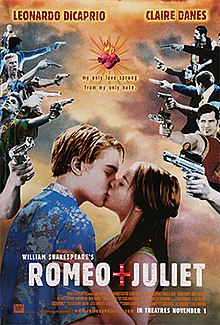
Romeo + Juliet 1996

William shakespeares romeo and juliet movie poster.jpgRomeo + Juliet is a 1996 American-Australian film adaptation of William Shakespeare's Romeo and Juliet. It was directed by Baz Luhrmann and stars Leonardo DiCaprio and Claire Danes in the leading roles. The film is an abridged modernization of Shakespeare's play. While it retains the original Shakespearean dialogue, the Montagues and the Capulets are represented as warring business empires and swords are replaced by guns (with brand names such as "Dagger" and "Sword").Some of the names were also changed. Lord and Lady Montague and Lord and Lady Capulet were given first names (as opposed to the Shakespeare original where their first names are never mentioned), Friar Lawrence became Father Lawrence, and Prince Escalus was renamed Captain Prince. There was also no Friar John, who was in the original play. Also, some characters were switched from one family to the other—in the original, Gregory and Sampson are Capulet, but in the film, they are Montagues. (Abra and Petruchio, conversely, are shifted from the Montague to the Capulet family.)In addition, a few plot details were shifted, most notably near the ending.
      In the fictional modern-day location "Verona Beach", the Capulets and the Montagues are arch-rivals.[3] The animosity of the older generation—Fulgencio and Gloria Capulet and Ted and Caroline Montague—is felt by their younger relatives. A gunfight between the Montague boys led by Benvolio, Romeo's cousin, and the Capulet boys led by Tybalt, Juliet's cousin, creates chaos in the city. The Chief of Police, Captain Prince, reprimands the families, warning them that if such behavior continues, their lives "shall pay the forfeit of the peace".
Benvolio meets with Romeo on a beach. Whilst playing a game of pool they learn of a party being held by the Capulets that evening which they decide to gate-crash (Romeo agreeing to come after discovering that his 'crush' Rosaline is attending).
The Montague boys meet their friend, Mercutio, who has tickets to the Capulet party. Romeo takes the Ecstasy pill Mercutio gave him and they proceed to the Capulet mansion. The effects of the drug and the party overwhelm Romeo, who goes to the rest-room. While admiring an aquarium, he and Juliet see each other. Tybalt spots Romeo and vows to kill him for invading his family's home, but Fulgencio stops him.
Director: Baz Luhrmann
Adapted from: Romeo and Juliet
Featured songs: Kissing You, #1 Crush
Screenplay: Baz Luhrmann, Craig Pearce

Marvin's Room 1996

Marvins room poster.jpgMarvin's Room is a 1996 American drama film based on the play of the same name by Scott McPherson The play, which was directed by David Petrarca, was adapted for the screen by McPherson and directed by Jerry Zaks. McPherson died of AIDS in 1992.It stars Meryl Streep, Leonardo DiCaprio, Diane Keaton, Robert De Niro, Hume Cronyn, Gwen Verdon, Hal Scardino and Dan Hedaya. Original music for the film was composed by Rachel Portman. Carly Simon wrote and performed the theme song "Two Little Sisters", with Meryl Streep adding background vocals.
     A man who had a stroke 17 years ago is left incapacitated and bed-ridden. He has been cared for by his daughter Bessie (Diane Keaton) in their Florida home, and totally ignored by his other daughter, Lee (Meryl Streep), who moved to Ohio with her husband 20 years ago and has never contacted her family. Now, however, Bessie's doctor has informed her that she has leukemia and needs a bone marrow transplant[4] and she turns to her sister for help. Lee, in turn, turns to her son Hank (Leonardo DiCaprio), who has been committed to a mental institution for setting fire to his mother's house. When Lee finds that she may have to take over her father's care, she at first begins shopping around for nursing homes. Eventually, however, the once-estranged family grows close.
Initial release: December 18, 1996 (New York City, Los Angeles)
Director: Jerry Zaks
Running time: 99 minutes
Screenplay: Scott McPherson
Awards: Chlotrudis Award for Best Supporting Actor, Christopher Award for Motion Pictures

Titanic 1997

The film poster shows a man and a woman hugging over a picture of the Titanic's bow. In the background is a partly cloudy sky and at the top are the names of the two lead actors. The middle has the film's name and tagline, and the bottom contains a list of the director's previous works, as well as the film's credits, rating, and release date.Titanic is a 1997 American epic romantic disaster film directed, written, co-produced, co-edited and partly financed by James Cameron. A fictionalized account of the sinking of the RMS Titanic, it stars Leonardo DiCaprio and Kate Winslet as members of different social classes who fall in love aboard the ship during its ill-fated maiden voyage.Cameron's inspiration for the film was predicated on his fascination with shipwrecks; he wanted to convey the emotional message of the tragedy and felt that a love story interspersed with the human loss would be essential to achieving this. Production on the film began in 1995, when Cameron shot footage of the actual Titanic wreck. The modern scenes were shot on board the Akademik Mstislav Keldysh, which Cameron had used as a base when filming the wreck. A reconstruction of the Titanic built at Playas de Rosarito in Baja California, scale models, and computer-generated imagery were used to recreate the sinking. The film was partially funded by Paramount Pictures and 20th Century Fox, and, at the time, was the most expensive film ever made, with an estimated budget of $200 million.
       In 1996, treasure hunter Brock Lovett and his team aboard the research vessel Keldysh search the wreck of RMS Titanic for a necklace with a rare diamond, the Heart of the Ocean. They recover a safe containing a drawing of a young woman wearing only the necklace. It is dated April 14, 1912, the day the ship struck the iceberg.[Note 1] Rose Dawson Calvert, claiming to be the person in the drawing, visits Lovett and tells of her experiences aboard the ship.In 1912 Southampton, 17-year-old first-class passenger Rose DeWitt Bukater, her fiancé Cal Hockley, and her mother Ruth board the Titanic. Ruth emphasizes that Rose's marriage will resolve the DeWitt Bukaters' financial problems. Distraught over the engagement, Rose considers committing suicide by jumping from the stern; Jack Dawson, a penniless artist, convinces her not to. Discovered with Jack, Rose tells Cal that she was peering over the edge and Jack saved her from falling. Cal is indifferent, but when Rose indicates some recognition is due, he offers Jack a small amount of money. After Rose asks whether saving her life meant so little, he invites Jack to dine with them in first class the following night. Jack and Rose develop a tentative friendship, though Cal and Ruth are wary of him. Following dinner, Rose secretly joins Jack at a party in third class.Aware of Cal and Ruth's disapproval, Rose rebuffs Jack's advances, but later realizes that she prefers him over Cal. After rendezvousing on the bow at sunset, Rose takes Jack to her state room and displays Cal's engagement present: the Heart of the Ocean. At her request, Jack sketches Rose posing nude wearing it. They evade Cal's bodyguard and have sex in an automobile in the cargo hold. They later visit the forward deck, witnessing a collision with an iceberg and overhearing the officers and designer discussing its seriousness.Cal discovers Jack's sketch of Rose and a mocking note from her in his safe along with the necklace. When Jack and Rose attempt to tell Cal of the collision, he has his butler slip the necklace into Jack's pocket and accuses him of theft. He is arrested, taken to the Master-at-arms' office, and handcuffed to a pipe. Cal puts the necklace in his own coat pocket.With the ship sinking, Rose is desperate to free Jack. She flees Cal and her mother, who has boarded a lifeboat, and rescues him. They return to the boat deck, where Cal and Jack encourage her to board a lifeboat; Cal claims he can get himself and Jack off safely. After Rose boards one, Cal tells Jack the arrangement is only for himself. As her boat lowers, Rose decides that she cannot leave Jack and jumps back on board. Cal takes his butler's pistol and chases Rose and Jack into the flooding first class dining saloon. After using up his ammunition, Cal realizes he gave his coat and consequently the necklace to Rose. He later boards a lifeboat by carrying a lost child.After braving several obstacles, Jack and Rose return to the boat deck. All the lifeboats have departed and passengers are falling to their deaths as the stern rises out of the water. The ship breaks in half, lifting the stern into the air. Jack and Rose ride it into the ocean and he helps her onto a wooden panel only buoyant enough for one person. Holding the edge, he assures her that she will die an old woman, warm in her bed. He dies of hypothermia but she is saved.
With Rose hiding from Cal en route, the RMS Carpathia takes the survivors to New York. There she gives her name as Rose Dawson. She later learns that Cal committed suicide after losing everything in the 1929 Wall Street Crash.Hearing Rose's story, Lovett abandons his search. Alone on the stern of the Keldysh, Rose takes out the Heart of the Ocean—in her possession all along—and drops it into the sea over the wreck site. While she is seemingly asleep in her bed, photos on her dresser depict a life of freedom and adventure, partly inspired by Jack. A young Rose reunites with him at the ship's Grand Staircase, applauded by those who perished.
Initial release: November 18, 1997 (London)
Director: James Cameron
Running time: 195 minutes
Featured song: My Heart Will Go On
Awards: [Academy Award for Best Picture, Academy Award for Best Original Music Score, Golden Globe Award for Best Motion Picture – Drama, MTV Movie Award for Best Movie, Academy Award for Best Director, Kids' Choice Award for Favorite Movie, Academy Award for Best Cinematography, Academy Award for Best Visual Effects, Online Film Critics Society Award for Best Supporting Actress, Academy Award for Best Film Editing, Academy Award for Best Costume Design, Academy Award for Best Sound Editing, Academy Award for Best Sound Mixing, Academy Award for Best Production Design, Golden Globe Award for Best Original Score, Golden Globe Award for Best Director - Motion Picture, People's Choice Award for Favorite Movie, American Society of Cinematographers Award for Outstanding Achievement in Cinematography in Theatrical Releases, Satellite Award for Best Film, Screen Actors Guild Award for Outstanding Performance by a Female Actor in a Supporting Role, Satellite Award for Best Art Direction and Production Design, Satellite Award for Best Costume Design, Kansas City Film Critics Circle Award for Best Supporting Actress, MTV Movie Award for Best Male Performance, Japan Academy Prize for Outstanding Foreign Language Film, Saturn Award for Best Supporting Actress, Satellite Award for Best Editing, Broadcast Film Critics Association Award for Best Director, Satellite Award for Best Director, Golden Reel Award for Best Sound Editing - Dialogue and ADR in a Feature Film, Satellite Award for Best Original Score, Chicago Film Critics Association Award for Best Original Score, Online Film Critics Society Award for Best Director, Kansas City Film Critics Circle Award for Best Director, DGA Award for Outstanding Directorial Achievement in Feature Film, Las Vegas Film Critics Society Award for Best Song, Las Vegas Film Critics Society Award for Best Director, European Film Awards Audience Award for Best Actress, Annie Award for Best Individual Achievement: Technical Achievement, Amanda Award for Best Foreign Feature Film, Blockbuster Entertainment Award for Favorite Supporting Actress - Drama, ASCAP Film and Television Music Awards for Most Performed Songs From Motion Pictures, ASCAP Film and Television Music Award for Top Box Office Films, Hochi Film Award for Best Foreign Film, People's Choice Award for Favorite Dramatic Movie, Los Angeles Film Critics Association Award for Best Production Design, Kansas City Film Critics Circle Award for Best Film, PGA Producer of the Year Award for Motion Picture Producer of the Year, Blue Ribbon Award for Best Foreign Language Film, Golden Camera Award for Film - International,]

The Quick and the Dead 1995

The-Quick-And-The-Dead-Poster.jpgThe Quick and the Dead is a 1995 western film directed by Sam Raimi and starring Sharon Stone, Gene Hackman, Russell Crowe and Leonardo DiCaprio. The story focuses on "The Lady" (Stone), a gunfighter who rides into the frontier town of Redemption, controlled by John Herod (Hackman). The Lady joins a deadly dueling competition in an attempt to exact revenge for her father's death.
Simon Moore's script was purchased by Sony Pictures Entertainment in May 1993, and actress Sharon Stone signed on as both star and co-producer. Development was fast tracked after director Sam Raimi's hiring, and principal photography began in Old Tucson Studios in Arizona on November 21, 1993. The film was distributed by TriStar Pictures and Columbia Pictures, and was released in the US on February 10, 1995 to a dismal box office performance, and received mixed reviews from critics.
      An unnamed gunslinger, referred to as The Lady, enters the Old West town of Redemption circa 1881 where she enters a single elimination gunfighting contest held by Redemption's ruthless leader, John Herod, a former outlaw. She meets Cort, a former Herod henchman turned reverend, whom Herod captures and forces to enter the contest, and Fee "The Kid" Herod, a brash young gun shop owner who hopes to impress Herod, whom he believes to be his father, by winning the contest. Though now a preacher, Cort is an amazingly fast and talented gunfighter, and the only man that Herod truly respects and fears. Herod covers this by treating Cort cruelly, denying him water, beating him and keeping him chained to an old fountain.
The first duels of all three go well, as does Herod's duel where he kills braggart Ace Hanlon, who had taken credit for some of Herod's own accomplishments. The Lady's duel goes well as she defeats an old enemy she left shackled to a wagon. Cort's duel also goes well, as he defeats one of Herod's men who thought he was getting an easy kill. Herod later learns that the townspeople have secretly hired a bounty hunter, Clay Cantrell, to enter the contest and kill him, but he kills Cantrell instead. Herod then angrily informs the townspeople that since they had so much money to hire Cantrell, he's going to raise taxes.
Initial release: February 10, 1995
Director: Sam Raimi
Running time: 108 minutes
Initial DVD release: September 29, 1998
Screenplay: Simon Moore

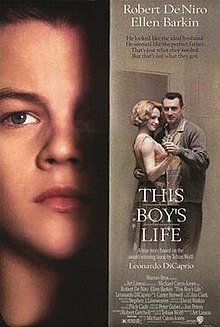
This Boy's Life 1993

This Boys Life.jpgThis Boy's Life is a 1993 film adaptation of the memoir of the same name by Tobias Wolff. It is directed by Michael Caton-Jones and stars Leonardo DiCaprio as Tobias Wolff, Robert De Niro as stepfather Dwight Hansen, and Ellen Barkin as Toby's mother, Caroline. The film also features Chris Cooper, Carla Gugino, Eliza Dushku, and Tobey Maguire in his feature film debut.
      Nomadic, flaky Caroline Wolff (Ellen Barkin) just wants to settle down in one place, find a decent man, and provide a better home for her and her son, Tobias "Toby" Wolff (Leonardo DiCaprio). When she moves to Seattle, Washington, and meets the seemingly respectable Dwight Hansen (Robert De Niro) (in real life Dwight Thompson worked as a mechanic for Seattle City Light at the time), she thinks she has it made. Toby, however, comes to feel differently; Dwight's true personality is revealed after Toby spends a few months separated from his mother with Dwight and his children. The boy's stepfather-to-be seems to want to mold Toby into a better person, but his method includes emotionally, verbally, and physically abusing the boy.The marriage proceeds, and soon Caroline too recognizes Dwight's need to dominate everyone around him. She sticks with it, though, convinced this is best for her son, and several years of dysfunction ensue. During this time, Toby befriends a classmate, the misfit and ambiguously homosexual Arthur Gayle (Jonah Blechman). Toby continues to chafe under the yoke of his repressive stepfather. Hoping to leave Concrete and live with his older brother Gregory, Toby decides to apply for East Coast prep-school scholarships. Realizing his grades are not good enough to be accepted, Toby devises a plan to submit falsified grade reports. Meanwhile, the friendship between Arthur and Toby becomes strained when Arthur confronts Toby, saying he is behaving more and more like Dwight, and asks, "Why should you be the one who gets to leave?" Even so, Arthur helps his friend get the papers he needs to falsify his grade records and Toby sends off his prep-school applications. When Toby assures Arthur he too can leave Concrete and have a better life, Arthur replies he will most likely stay. After numerous rejections, Toby is finally accepted by the Hill School in Pottstown, Pennsylvania, with a full scholarship.
Initial release: April 9, 1993 (USA)
Director: Michael Caton-Jones
Adapted from: This Boy's Life: A Memoir
Story by: Tobias Wolff
Characters: Dwight Hansen, Caroline Wolff Hansen, Tobias "Toby" Wolff, Chuck Bolger, Norma, Pearl

Critters 3 1991

Critters 3.jpgCritters 3 is a 1991 sci-fi comedy horror film directed by Kristine Peterson. It is the third installment of the Critters series, the sequel to Critters and Critters 2 and Leonardo DiCaprio's film debut. Actor Cary Elwes mentioned on the commentary for the uncut edition DVD of Saw that he passed on the role of Josh. It was shot back-to-back with its sequel, Critters 4. Unlike the first two movies, it does not take place in the town of Grover's Bend.
      Sometime after the events in Critters 2, Charlie MacFadden is tracking down the last of the Critters. A family of three - Annie (the main protagonist), Johnny (her little brother) and Clifford (the father) - stops at a rest stop when their car's tire pops. At the rest stop, Charlie warns them and Josh, stepson of a corrupt landlord, about the Crites. As this happens, a Crite lays eggs under the family's car and the family leaves, unknowingly taking the eggs with them.
Soon after they arrive at their tenement, the Crites hatch and attack the sleazy maintenance man, Frank. When the landlord arrives, he too is eaten by the Crites after Josh locks him in Clifford's room, unknowingly trapping his stepfather with the creatures. Next, one of the residents is attacked and wounded. Annie, her family and five others (including Josh) try to get to safety in one piece by getting to the roof of the building. Charlie arrives and destroys the remaining Critters, saving the remaining tenants. The film ends in a cliffhanger as Charlie is about to destroy two Crite eggs, but is ordered not to and a containment pod sent from the Intergalactic Council crashes into the basement. Charlie puts the eggs into the pod, but accidentally traps himself inside.
Initial release: December 11, 1991
Director: Kristine Peterson
Running time: 94 minutes
Prequel: Critters 2: The Main Course
Sequel: Critters 4

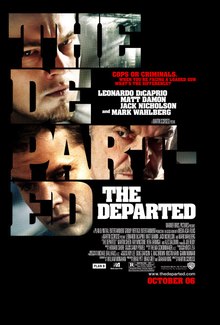
The Departed 2006

Departed234.jpgThe Departed is a 2006 American crime thriller film directed by Martin Scorsese and written by William Monahan. It is a remake of the 2002 Hong Kong film Infernal Affairs. The film stars Leonardo DiCaprio, Matt Damon, Jack Nicholson, and Mark Wahlberg, with Martin Sheen, Ray Winstone, Vera Farmiga, Anthony Anderson, and Alec Baldwin in supporting roles.
        Colin Sullivan (Damon) is introduced to organized crime by Irish-American mobster Frank Costello (Nicholson) in the Irish neighborhood of South Boston. Costello trains him in becoming a mole inside the Massachusetts State Police. Sullivan is accepted into the Special Investigations Unit, which focuses on organized crime.
 Initial release: September 26, 2006 (New York City)
Director: Martin Scorsese
Featured song: I'm Shipping Up to Boston
Sequel: Untitled The Departed 2 Sequel
Awards: Academy Award for Best Picture, Academy Award for Best Director, Academy Award for Best Writing Adapted Screenplay, Academy Award for Best Film Editing, MTV Movie Award for Best Villain, Golden Globe Award for Best Director - Motion Picture, Satellite Award for Best Film, National Board of Review Award for Best Cast, New York Film Critics Circle Award for Best Director, Satellite Award for Best Supporting Actor – Motion Picture, Austin Film Critics Association Awards, Writers Guild of America Award for Best Adapted Screenplay, Broadcast Film Critics Association Award for Best Director, DGA Award for Outstanding Directorial Achievement in Feature Film, Broadcast Film Critics Association Award for Best Film, National Society of Film Critics Award for Best Supporting Actor, National Board of Review Award for Best Ensemble, Edgar Award for Best Motion Picture Screenplay, National Board of Review Award for Best Director, Phoenix Film Critics Society Award for Best Supporting Actor, Satellite Award for Best Adapted Screenplay, Central Ohio Film Critics Association Award for Best Ensemble, Las Vegas Film Critics Society Award for Best Film Editing, Las Vegas Film Critics Society Award for Best Picture, Florida Film Critics Circle Award for Best Supporting Actor, Las Vegas Film Critics Society Award for Best Director, Satellite Special Achievement Award for Outstanding Motion Picture Ensemble
Loading

Labels

1931's Movies 1936's Movies 1940's Movies 1962's Movies 1963's Movies 1964's Movies 1965's Movies 1967's Movies 1969's Movies 1971's Movies 1973's Movies 1974's Movies 1977's Movies 1979's Movies 1981's Movies 1983's Movies 1985's Movies 1986's Movies 1987's Movies 1988's Movies 1989's Movies 1990's Movies 1991's Movies 1992's Movies 1993's Movies 1994's Movies 1995's Movies 1996's Movies 1997'Movies 1998'Movies 1999's Movies 2000's Movies 2001's Movies 2002's Movies 2003's Movies 2004's Movies 2005's Movies 2006's Movies 2007's Movies 2008's Movies 2009's Movies 2010's Movies 2011's Movies 2012's Movies 2013's Movies 2014's Films 2014's Movies 9121's Movies Absurdism Action Action Comedy Action Film Action Thriller Action/Adventure Adventure Comedy Adventure Film Alien Film Animation Anti-war film Auto racing B movie Biographical film Biography Black comedy Black-and-white Blaxploitation film Buddy cop film Buddy film Caper story Chase Movie Classic Movies Comedy Comedy Thriller Comedy-drama Coming of age Computer Animation Concert film Costume Adventure Costume drama Crime Crime Drama Crime Fiction Crime Thriller Cult film Danish Disaster Film Documentary Doomsday film Drama Dubbed In Hindi Dystopia ensemble Ensemble Film Epic film Erotic thriller Existentialism Family Family Drama Fantasy farce Fiction Film adaptation Film noir Film Review Full Movies Future noir Gangster Film Glamorized Spy Film HD Historical drama Historical fiction Horror Horror comedy Indie film James Bond films Kaiju Legal drama Leonardo DiCaprio LGBT Mark Wahlberg Melodrama Monster movie Music Musical Musical comedy Musical Drama Mystery Natural horror film Neo-noir New film Parody Part-talkie Period piece Plot Political cinema Political drama Political thriller Psychological thriller Reboot Release date remake Revenge Revenge Drama Road movie Romance Film Romantic comedy Satire Sci-Fi Adventure Sci-Fi Horror Science Fiction Screwball comedy Sex comedy Short Film Silent film Slapstick Slasher Spaghetti Western Sports Spy fiction Spy film Stop motion Superhero movie Suspense Swashbuckler film Teaser Teen Film Thriller Time travel Tom Cruise Trailer Trial drama War film Western Workplace Comedy World cinema Zombie Film